
In short, a Wood UV Drying Machine can rapidly cure UV-curable primers, topcoats, or putties in an extremely short time, resulting in high efficiency, low VOCs, and stable quality. However, it has stringent requirements for paint formulation, spectrum, and energy matching, and is sensitive to shaded areas, thick coatings, and dark, high-octane formulations. It also requires stricter management in terms of safety, maintenance, and investment.
What is a Wood UV Drying Machine? Why is it said that what it "dries" is actually "curing"?
A Wood UV Drying Machine uses ultraviolet light (mostly UVA and near-ultraviolet, but may also contain some UVB/UVC or use narrow-spectrum UV-LEDs) to irradiate a coating with a photoinitiator system, causing photopolymerization/crosslinking, transforming it from a liquid state into a highly crosslinked solid film.
• "Drying" ≠ Evaporation: Traditional hot air/infrared drying relies on evaporating solvents or promoting thermal curing reactions; UV, through photoinitiators, generates free radicals or cations, initiating oligomer/monomer crosslinking, essentially a chemical curing process.
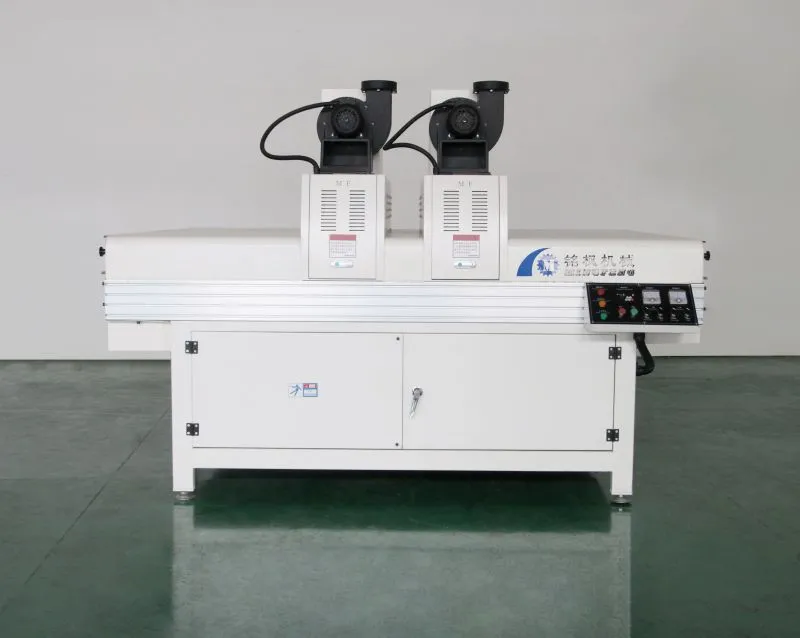
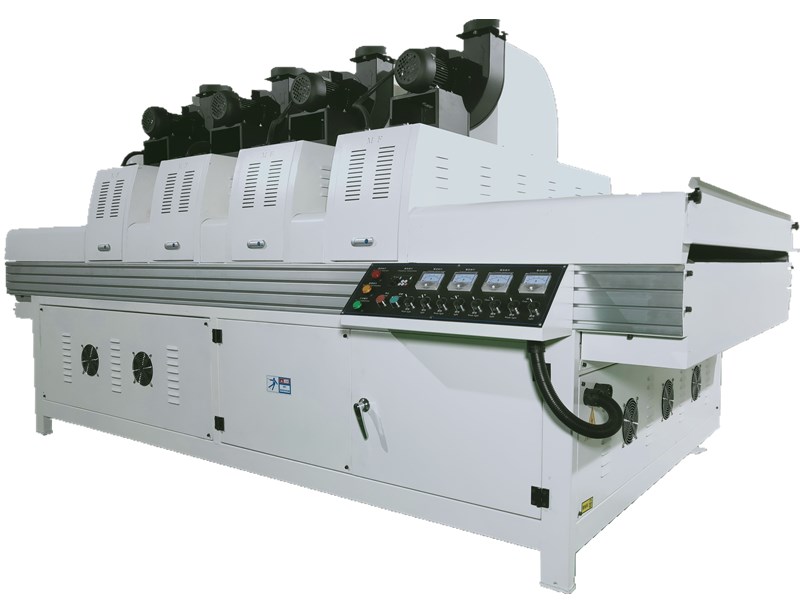
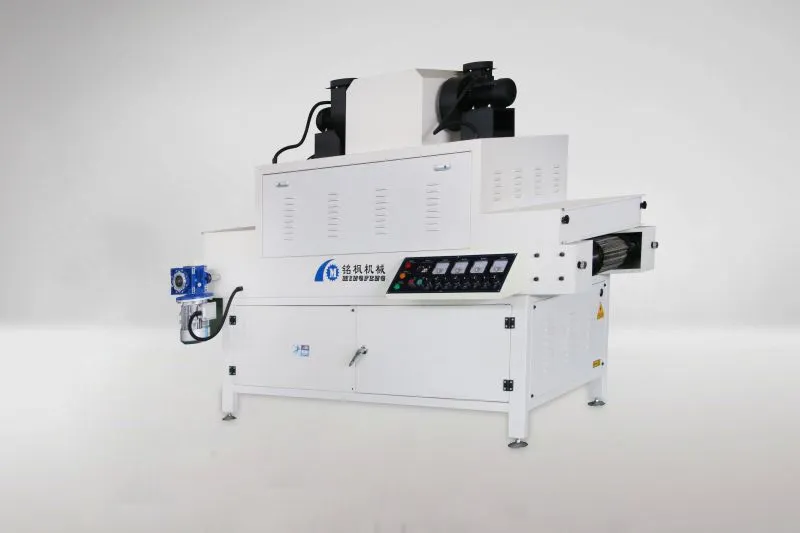
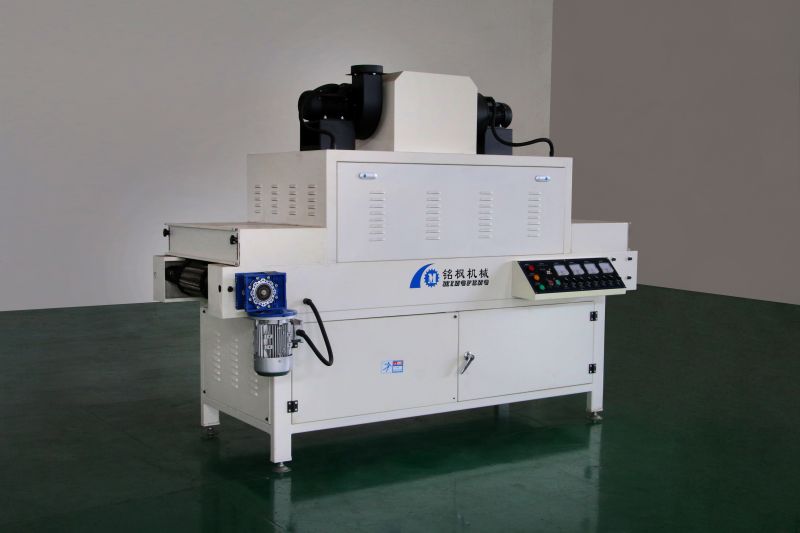
• Typical Structure: Light source module (mercury lamp or LED), reflection and light guiding system, conveying and speed control, cooling and ventilation, optical shielding and interlocking, control and monitoring unit.
• Common Workstations: Primer sealing layer curing, rapid putty sealing, instant film setting of coloring layer or clear topcoat, often integrated with roller coaters, spray coating lines, sanders, etc.
What are the advantages of a Wood UV Drying Machine?
It can be broken down from four dimensions: efficiency, quality, cost, and environmental protection:
1. Efficiency and Cycle Time
• Second-level curing: After the required energy dosage is achieved, "surface drying + solid curing" can be completed within a few seconds to tens of seconds. Products can be stacked/flipped/further processed immediately after exiting the line, significantly reducing work-in-process and turnaround time.
• Continuous and Reproducible: Synchronized with roller/spray coating conveyor lines at the same speed, ensuring stable cycle time and unaffected by operator feedback fluctuations.
2. Quality and Performance
• High Crosslinking Hardness and Abrasion Resistance: The UV-cured coating has a high crosslinking density, offering excellent scratch resistance, abrasion resistance, and chemical resistance, making it suitable for high-durability applications such as countertops, floors, and cabinet doors.
• Strong Appearance Consistency: Stable light source, constant speed, and controllable energy result in minimal batch-to-batch color difference and gloss fluctuations.
• Layered Design: Segmented energy control from base to color to surface allows for clear texture, fullness, and a premium feel.
3. Cost and Space
• Small Footprint: Compared to long-channel hot air drying tunnels, the UV section is shorter, the equipment is more compact, and factory space utilization is higher.
• Competitive Energy Consumption: Short curing time per unit; if using LED light sources, standby power consumption and heat load are even lower (requires formulation matching).
• Reduced Rework: The "acceptance upon delivery" attribute reduces rework and repair rates, indirectly lowering costs.
4. Environmental Protection and Compliance
• Low VOC Emissions: The 100% solid UV system has very low solvent content; the mixed system also has less volatile emissions in the UV segment, resulting in a smaller environmental burden.
• Clean Production: Enclosed light chambers + effective exhaust ventilation ensure relatively controllable dust adhesion and odor in the workshop.
What other "hidden advantages" are often overlooked?
• Friendly to temperature-sensitive substrates (compared to hot air): Especially with LED light sources having low infrared load, reducing the risk of wood warping or veneer stress.
• Fast Setup and Changeover: No need for prolonged heating/heat preservation; rapid switching of lamp units and power levels (more pronounced with LEDs).
• Online Monitoring and Closed-Loop Capability: Parameters such as irradiance, dose, temperature, line speed, and lamp spacing can be digitally recorded, facilitating traceability and SPC control.
• Compatible with Multiple Processes: Can be combined with roller coating, curtain coating, spray coating, and dip coating to form multi-stage coating strategies (such as base UV, top PU/water-based, or full UV systems).
What are the disadvantages of a Wood UV Drying Machine?
Which scenarios are unsuitable for Wood UV Drying Machines?
1. High dependence on formulation
• Must be a UV-curable coating: Ordinary solvent-based/water-based paints cannot form a film using UV light without a photoinitiator system and polymerizable components.
• Spectral matching: LEDs commonly use a narrow 385/395/405 nm spectrum, requiring matching with the photoinitiator response; mercury lamps, while having strong broad-spectrum compatibility, introduce ozone and heat load issues in the short wavelength range.
• Pigment masking: Dark colors, metallic powders, or high-filler systems absorb/scatter UV light, resulting in surface drying but incomplete curing.
2. Geometric and optical limitations
• Shadowing effect: Deep grooves, chamfered backs, and the inside of seams suffer from insufficient curing due to lack of light; complex 3D parts require flipping or multi-angle supplemental lighting.
• Difficulty in penetrating thick coatings: A single thick coating can easily lead to excessive surface cross-linking and unreacted interiors, requiring multiple thin coats for curing.
3. Heat and Substrate Risks
• Temperature rise leads to defects: bubbles, pinholes, yellowing, resin migration, substrate stress cracking, etc., especially noticeable with mercury lamps or when the lamp distance is too close.
• Sensitive to moisture content and surface cleanliness: moisture content in wood, grease/wax residue, and dust amplify adhesion and appearance risks.
4. Stricter Safety and Environmental Requirements
• UV leakage risk: requires light shielding, interlocking, protective glasses, and face shields;
• Ozone (shortwave from mercury lamps) and heat: requires ventilation and cooling;
• Mercury lamp disposal: treated as hazardous waste; LEDs are mercury-free but require ESD/heat dissipation management.
5. Investment and Maintenance
• Higher initial equipment investment: especially for high-power multi-segment LEDs or wide-width production lines;
• Increased maintenance intensity: reflector cleaning, lamp life maintenance, irradiance calibration, sealing, and light window maintenance are essential;
• Narrow process window: slight deviations in dosage, speed, and distance result in defects, requiring strict SOPs and quality control. Scenarios where Wood UV Drying Machines are not suitable or require caution:
Projects without UV formulations; projects requiring thick-film one-step molding, dark high-opacity coatings that do not allow for delamination; three-dimensional parts with many shadows and lacking multi-faceted irradiation capabilities; thin substrates that are extremely heat-sensitive and cannot be adequately cooled; workshops where safety management requirements cannot be met.
Advantages and disadvantages of LED-UV versus mercury lamps in Wood UV Drying Machines?
1. LED-UV (mostly 385/395/405 nm)
• Advantages: Narrow spectrum, low heat generation, ready to use immediately, long lifespan, low energy consumption/maintenance, ozone-free, mercury-free; friendly to wood warping and yellowing.
• Disadvantages: High requirements for formulation; weak response to some traditional photoinitiators; narrower curing window for dark/high-filler systems; peak irradiance and irradiation uniformity require careful design.
2. Mercury Lamps (Medium-pressure mercury lamps, etc., broad-spectrum)
• Advantages: Rich spectral range, strong compatibility with traditional UV formulations; high instantaneous peak power, good penetration and surface activation ability.
• Disadvantages: High heat load, may produce ozone, contains mercury; requires preheating and stabilization, frequent maintenance; higher requirements for equipment shading, ventilation, and safety management.
Traditional Considerations: If the formulation is adjustable and energy consumption/thermal management/environmental protection and ease of maintenance are prioritized, most wood paneling tends to favor LEDs; if existing mercury lamp formulations are used and broad-spectrum tolerance and penetration are prioritized, traditional mercury lamps still have advantages, but require more robust safety and environmental protection facilities.
Wood UV Drying Machine VS. Traditional Drying Methods like Hot Air/Infrared/Microwave
• Speed: UV (seconds) > Infrared (minutes) ≈ Hot Air (minutes to tens of minutes);
• Footprint: UV chamber is short, hot air drying duct is long and requires a large footprint;
• Energy Consumption: UV energy is concentrated and the drying time is short; hot air requires heating a large volume of air and the equipment housing, resulting in high heat loss;
• Coating Properties: UV has high crosslinking density, strong hardness and chemical resistance; hot air/infrared relies on solvent evaporation or thermal curing, resulting in good appearance but hardness/wear resistance depends on the formulation;
• Adaptability: Hot air/infrared is not sensitive to shading and geometry; UV is sensitive to shading and masking;
• Environmental Protection: UV (especially 100% solids) has lower VOCs; hot air/infrared, if using more solvents, requires stronger RTO/activated carbon treatment;
• Window Width: Hot air has a more forgiving process window; UV has a narrower window, requiring precise dosage control.
How to maximize the advantages of a Wood UV Drying Machine?
• Layered thin coating, multiple curing: Each layer is controlled within a penetrable thickness range to avoid surface drying followed by internal curing incomplete drying.
• Spectrum and initiator matching: LED wavelength matches the initiator response peak; mercury lamps can use filters to suppress excessively short wavelengths, reducing yellowing and ozone.
• Dosage/intensity/linear speed closed-loop: Online dosimeter, irradiance monitoring, temperature point monitoring + speed closed-loop, forming a process map of "energy—temperature rise—appearance".
• Cooling and ventilation: Control the surface temperature rise of the workpiece; mercury lamps are equipped with sufficient airflow and ozone is treated.
• Substrate and pretreatment: Control moisture content, remove oil and micro-powder, primer/sealant first, sanding for stable gradation.
• Masking and multi-angle irradiation: Design flip or side light sources for complex parts, and locally shield sensitive surfaces when necessary.
• SOP and training: Establish standards for coating amount, linear speed, lamp spacing, power, temperature, cleaning frequency, etc.; operators and maintenance personnel must pass the assessment before being allowed to work.
• Sample Verification: Before each paint, color, or substrate change, a small sample is made to confirm adhesion, hardness, solvent resistance, ΔE, and appearance before scaling up production.
What cooperation models does XMF Machinery offer to buyers?
XMF Machinery provides flexible cooperation models for buyers, including direct sales, wholesale distribution, and long-term supply contracts. Whether you are a factory purchasing equipment for internal use or a reseller seeking a trusted brand, we can provide competitive quotes, attractive promotions, and reliable delivery. Our company adapts to your purchasing needs to maximize efficiency and cost savings.