
Curtain Coating Production Line: What is the Curtain Coating Process Flow?
In the field of surface coating for panel materials, balancing the need to ensure coating uniformity with the goal of boosting production efficiency has long been a key focus for manufacturers. Compared to traditional spray coating or roller coating methods, the Curtain Coating Production Line has gained widespread application in the finishing of furniture panels, decorative boards, flooring, and composite materials, thanks to its consistent coating coverage and high paint utilization efficiency.
Many users who are new to this equipment often raise a fundamental question:
What exactly is the process flow of a curtain coating production line?
In reality, a complete curtain coating production line is not merely a single curtain coating machine; rather, it is an automated production system comprising a combination of various equipment units. From the moment the panel enters the line until the coating is fully cured and the finished product is discharged, the material undergoes a series of continuous processing stages.
This article will systematically explain the complete process flow of a curtain coating production line—covering equipment structure, procedural steps, and operational logic—to help readers gain a comprehensive understanding of how this coating technology functions.
What is a Curtain Coating Production Line?
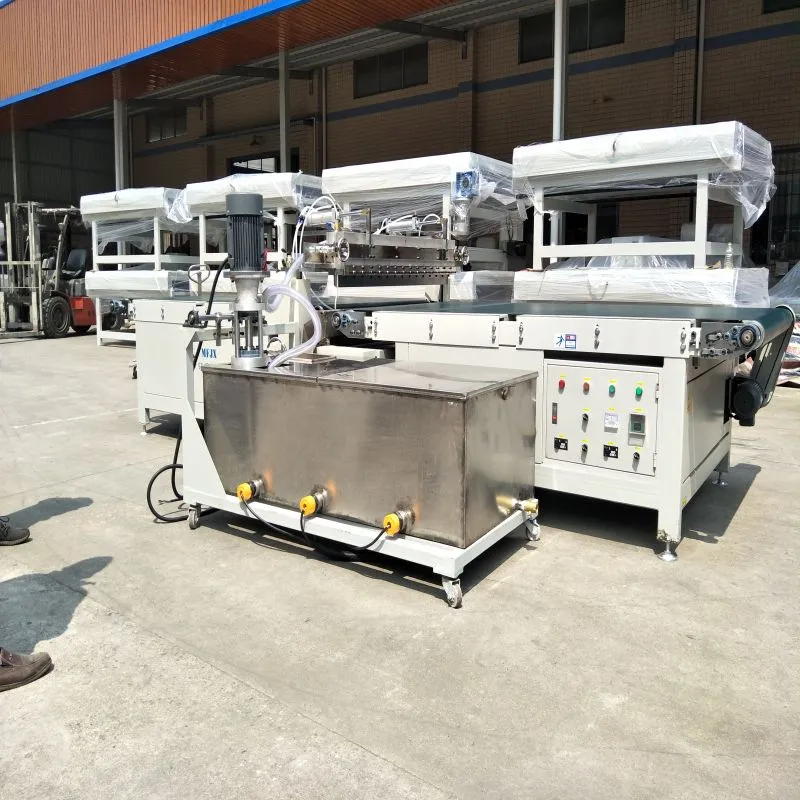
A curtain coating production line is an automated coating system designed to cover the surface of panel materials by generating a stable "curtain" of coating material. As a panel passes through this liquid curtain, the coating material falls evenly onto its surface, thereby forming a continuous and uniform layer.
Compared to other coating methods, the curtain coating production line offers the following advantages:
•Uniform coating thickness
•High paint utilization efficiency
•Excellent surface flatness
•Suitable for large-format panels
•High degree of automation
Due to these characteristics, curtain coating production lines are frequently employed in the manufacturing of panels that require superior surface quality.
What is the Basic Working Principle of a Curtain Coating Production Line?
The core principle behind a curtain coating production line is the utilization of gravity to form a stable liquid curtain, allowing the coating material to spread evenly across the surface of the panel.
The operational process of a curtain coating production line typically involves the following steps:
1.The coating material is pumped to the top of the curtain coater.
2.The coating flows out through a precision slot die, forming a continuous liquid curtain.
3.The substrate (board) passes through the liquid curtain on a conveyor belt.
4.The coating uniformly covers the surface of the substrate.
5.Excess coating material is recovered and recirculated by a recovery system.
In this manner, a curtain coating production line achieves continuous and highly efficient coating application.
What is the process flow of a curtain coating production line?
From the perspective of the overall production structure, a standard curtain coating production line typically comprises the following process steps:
Infeed
→ Dust Removal
→ Curtain Coating
→ Leveling
→ Drying & Curing
→ Cooling
→ Outfeed
Each process step is executed by corresponding equipment, and these units are arranged sequentially to form a complete curtain coating production line.
Each of these process steps will be explained in detail below.
Why does a curtain coating production line require an infeed conveying system?
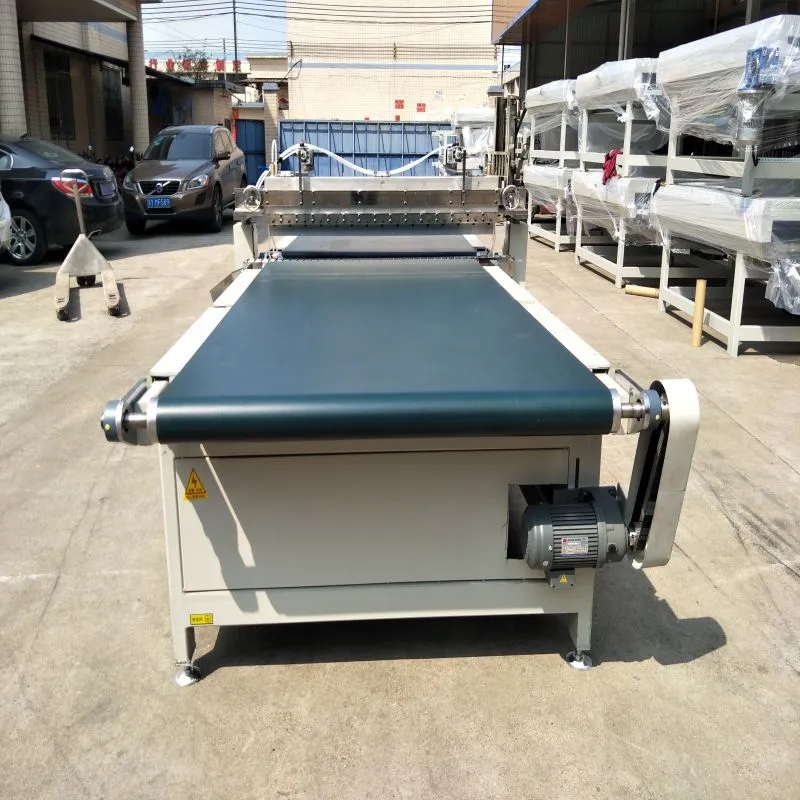
Within a curtain coating production line, the substrate must pass through multiple pieces of equipment; therefore, it is essential to be equipped with a stable conveying system.
The primary functions of the infeed conveyor include:
•Feeding the substrate into the production line in a stable manner.
•Controlling the speed of the production line.
•Ensuring the positional stability of the substrate.
The conveying system typically utilizes belt conveyors or roller conveyors, with speed regulation achieved through variable frequency control. A stable conveying system serves as the foundation for ensuring the smooth and proper operation of the curtain coating production line.
Why is a dust removal step mandatory in a curtain coating production line?
During the substrate coating process, dust is a critical factor that impacts coating quality. If dust or particulate matter is present on the substrate surface, surface defects will inevitably occur once the coating process is complete.
Consequently, curtain coating production lines are typically equipped with dust removal devices, such as:
•Brush-type dust removers
•Electrostatic dust removers
•Air knife dust removal systems
These devices effectively remove dust from the substrate surface, keeping it clean and thereby enhancing the overall quality of the coating.
What role does the curtain coater play within the production line?
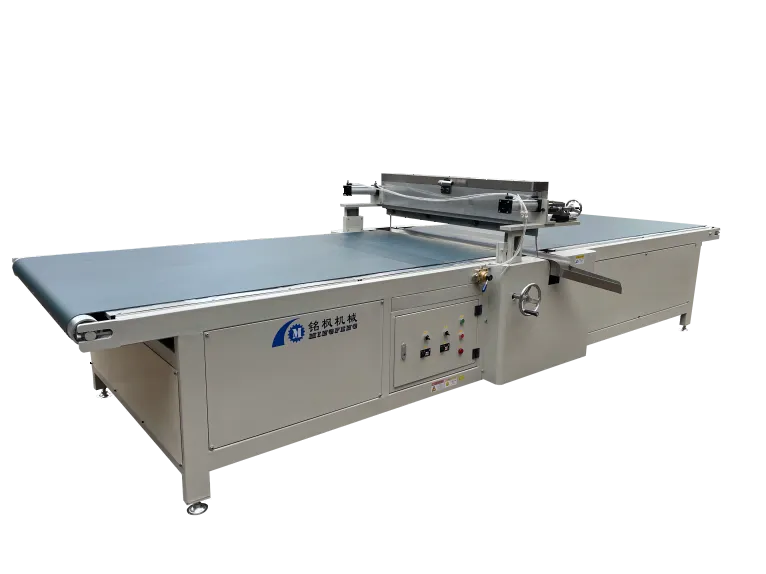
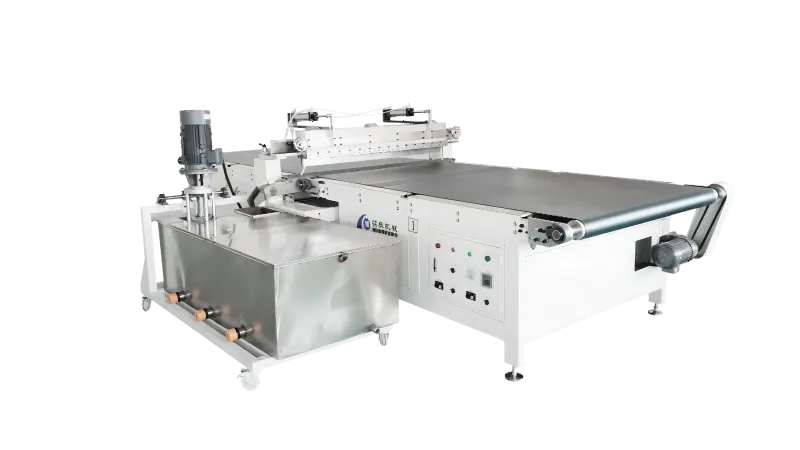
Throughout the entire curtain coating production line, the curtain coater itself serves as the most critical and central piece of equipment. A curtain coater utilizes a precisely engineered discharge slot to generate a stable curtain of coating material; as the substrate passes through this liquid curtain, the coating is applied uniformly across its surface.
A curtain coater typically comprises the following key components:
•Coating Supply System
•Precision Flow Slot Mechanism
•Coating Recovery System
•Conveyor Platform
Together, these components ensure the stable flow of the coating curtain, thereby achieving a uniform application.
Within a curtain coating production line, one or more curtain coaters may be deployed to execute different layers of the coating process.
Why is a leveling stage necessary in a curtain coating production line?
After the substrate passes through the curtain coater, the coating—though already covering the surface—remains in a liquid state. At this juncture, a certain amount of time is required to allow surface tension to take effect, enabling the coating to self-level and become smooth.
This process is known as "leveling." The leveling stage is typically achieved by extending the conveyor distance; occasionally, it is augmented by an air circulation system to further enhance the smoothness of the coating surface.
The primary functions of the leveling stage include:
•Eliminating ripples or waves in the coating
•Enhancing surface smoothness
•Ensuring uniform coating thickness
Without a leveling stage, the coating surface may exhibit irregularities or unevenness.
How is the drying and curing process executed in a curtain coating production line?
Once the leveling stage is complete, the substrate proceeds to the drying or curing phase.
Depending on the specific type of coating used, curtain coating lines typically employ various types of drying equipment, such as:
•UV Curing Machines
•Infrared Drying Equipment
•Hot Air Dryers
These devices facilitate the rapid curing of the coating, thereby forming a stable paint film structure.
The drying and curing process not only impacts production efficiency but also directly influences the hardness, adhesion, and abrasion resistance of the resulting paint film. In a curtain coating line, drying equipment typically occupies a significant amount of floor space, as sufficient time must be allotted to ensure thorough drying.
Why is a cooling stage required in a curtain coating production line?
Following the drying and curing process, the surface temperature of the substrate is typically elevated; therefore, it must undergo a cooling treatment. The primary functions of the cooling process include:
•Reducing the temperature of the substrate panels
•Preventing the coating from sticking or adhering
•Ensuring the dimensional stability of the panels
Cooling equipment typically operates via a circulating cold air system, allowing the panels to return to ambient temperature before exiting the curtain coating production line.
What is the function of the discharge system in a curtain coating production line?
Upon completion of all processing steps, the panels exit the curtain coating production line via a discharge conveyor.
The primary functions of the discharge system include:
•Transporting the finished panels out of the production line
•Ensuring the panels remain neatly aligned
•Facilitating subsequent packaging or further processing
A stable discharge system is essential for ensuring the continuous operation of the entire curtain coating production line.
What is the typical equipment layout for a curtain coating production line?
The equipment arrangement for a typical curtain coating production line is generally as follows:
Infeed Conveyor
→ Dust Removal Equipment
→ Curtain Coater
→ Leveling Conveyor Section
→ Drying Equipment
→ Cooling Equipment
→ Discharge Conveyor
In actual production scenarios, depending on specific product processing requirements, a curtain coating production line may be configured with multiple curtain coating machines or multiple drying sections to accommodate diverse coating process needs.
What are the key process control points for a curtain coating production line?
To ensure the stable operation of a curtain coating production line, it is necessary to monitor and control several process parameters, including:
1. Conveying Speed
The conveying speed determines the dwell time of the panels beneath the liquid curtain, thereby influencing the coating thickness.
2. Coating Viscosity
Coating viscosity directly affects the stability of the liquid curtain; if the viscosity is either too high or too low, it may result in an uneven coating.
3. Coating Flow Rate
The coating flow rate must be synchronized with the production line speed to ensure a continuous and stable liquid curtain.
4. Environmental Conditions
Temperature and humidity also influence the flow properties of the coating material; therefore, the production environment must be maintained under stable conditions.
The proper control of these parameters is a critical prerequisite for ensuring the stable and reliable operation of the curtain coating production line.
What is the process workflow for a curtain coating production line?
A complete curtain coating production line typically comprises the following process stages:
1.Panel Feeding
2.Surface Dust Removal
3.Curtain Coating
4.Coating Leveling
5.Drying and Curing
6.Cooling Treatment
7.Finished Product Discharge
Each stage of the process is executed by specialized equipment; these units are arranged sequentially according to the production workflow, thereby forming a continuous, automated curtain coating production line.
This production method enables highly efficient and high-quality surface coating of panels, making it particularly well-suited for the industrial-scale production of large-area flat materials.