

In modern furniture manufacturing, the quality of the surface coating directly determines the product's appearance, texture, and durability. To achieve high-gloss, high-hardness, and scratch-resistant coatings, more and more furniture factories are using furniture UV dryers for film curing.
However, in practical use, many users often wonder:
What film thickness is suitable for a furniture UV dryer machine?
Will a film that is too thin cure completely? Will a film that is too thick affect the drying effect?
These questions seem simple, but they involve multiple technical factors such as the UV curing mechanism, energy penetration, coating characteristics, and equipment configuration. This article will provide a systematic analysis from a professional perspective to help you fully understand the suitable range and key control points for film thickness when using a furniture UV dryer machine.
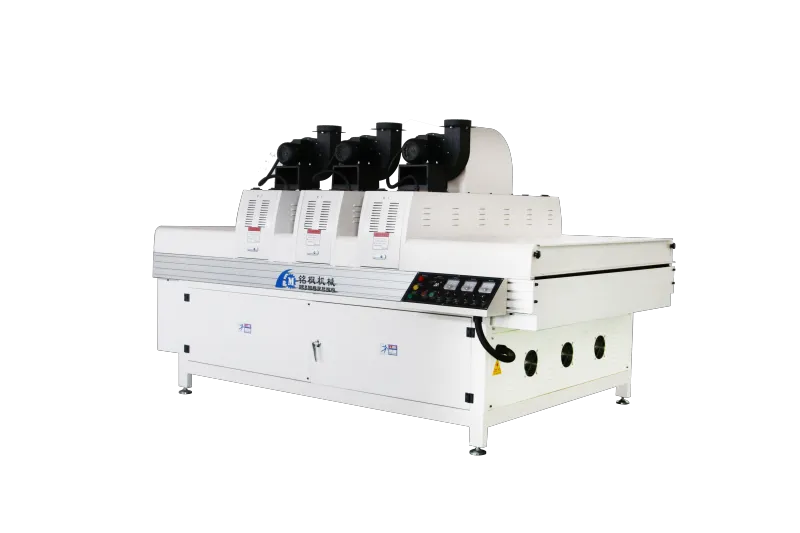
Why does film thickness affect the curing effect of a furniture UV dryer machine?
Film thickness is one of the core factors affecting the UV curing effect.
The working principle of a furniture UV dryer machine is to use high-intensity ultraviolet (UV) light to irradiate a UV coating containing a photoinitiator, causing it to undergo a polymerization reaction instantly, transforming it from a liquid to a solid state.
However, ultraviolet light has a limited penetration depth.
If the coating film is too thick, the light cannot reach the deeper areas, resulting in surface curing while the interior remains uncured, leading to:
• A hard surface but a soft inner layer;
• Bubbling or peeling of the coating;
• Uneven gloss or stickiness.
Conversely, if the coating film is too thin, it may result in:
• Uneven coverage;
• Inability to form an effective protective layer;
• Insufficient gloss and fullness.
Therefore, controlling the coating film thickness is a prerequisite for the furniture UV dryer machine to achieve optimal performance.
What is the principle behind the furniture UV dryer machine's adaptability to different coating film thicknesses?
The design structure and light source configuration of the furniture UV dryer machine determine its adaptability range for coating film thickness. Generally, it depends on three key technical parameters:
1. UV Energy Density
The higher the energy density (unit: mJ/cm²), the stronger the penetration ability of ultraviolet light.
High-energy-output furniture UV dryers can cure thicker paint films, generally suitable for coatings with a thickness of 30–60 μm (micrometers).
Lower-energy devices are mostly used for curing thinner layers of 5–20 μm.
2. Light Source Wavelength
Different wavelengths of UV light penetrate coatings to different depths:
• Short-wavelength (UVC, 200–280nm): High energy, fast surface curing;
• Medium-wavelength (UVB, 280–320nm): Suitable for both surface and shallow layers;
• Long-wavelength (UVA, 320–400nm): Strong penetration, suitable for thick film curing.
Therefore, furniture UV dryers often use metal halide lamps or LED-395nm light sources to achieve deep curing of medium-thickness coatings.
3. Irradiation Time and Conveyor Speed
The conveyor speed and lamp power of a UV dryer are adjustable.
• Slow speed → Longer irradiation time → Higher light dose → Suitable for curing thick films;
• High speed → Suitable for thin film curing.
For example:
• Speed 5m/min → Can cure a thickness of approximately 50μm;
• Speed 15m/min → Suitable for curing films of approximately 15μm.
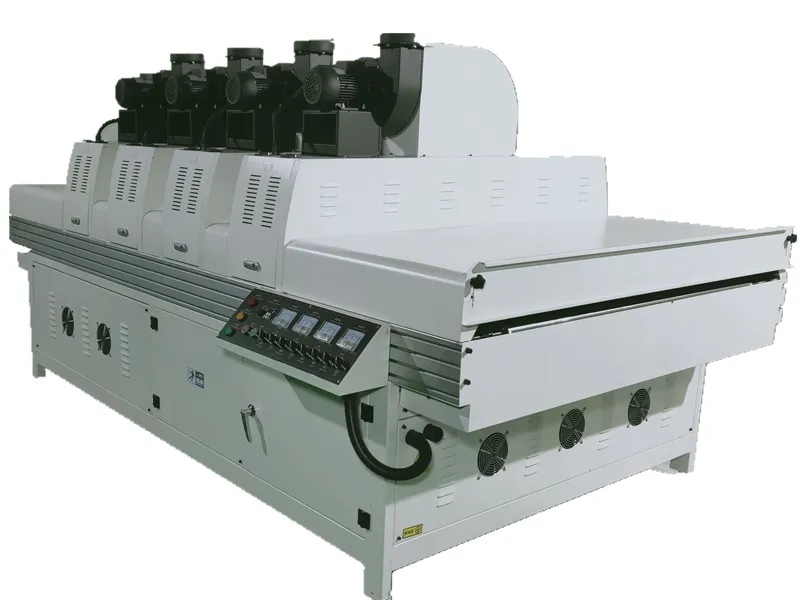
What are the effects of excessively thick or thin coatings on UV drying performance?
1. Effects of Excessively Thick Coating Film
When the coating thickness exceeds 60μm, even with a high-energy UV light source in the furniture UV dryer, the following problems are likely to occur:
• Incomplete curing: UV rays cannot penetrate to deeper layers;
• Surface wrinkling or shrinkage: The inner layer continues to flow after the surface layer has cured;
• Whitening and poor gloss: High reflectivity leads to energy loss;
• Reduced adhesion: The underlying layer is not fully cross-linked.
2. Effects of Excessively Thin Coating Film
If the thickness is less than 5μm:
• Poor hiding power: Wood grain or base color shows through;
• Insufficient abrasion resistance: The protective layer is too thin;
• Uneven gloss: Difficulty in forming a smooth reflective surface;
• Prone to over-curing: Excessive irradiation may cause the coating film to become brittle.
Therefore, during production, the coating amount, viscosity, and coating pressure should be controlled to ensure the coating film is within the optimal curing thickness range of the furniture UV dryer.
What are the main factors affecting the cured coating thickness of a furniture UV dryer?
To accurately control film thickness and curing effect, the influence of both equipment and materials must be considered.
1. Photoinitiator Content in Coating Formulation
• High photoinitiator concentration → Faster reaction speed → Suitable for thick films;
• Low photoinitiator concentration → Insufficient energy → Only suitable for thin films.
2. Lamp Energy and Distance
• Higher lamp wattage results in greater light intensity;
• Closer lamp distance results in higher energy density;
• Generally, a lamp distance of 5–10 cm is optimal.
3. Conveyor Belt Speed
• Faster speed → Shorter exposure time → Suitable for thin films;
• Slower speed → Greater energy accumulation → Suitable for thick films.
• Ideally, the conveyor speed should be automatically adjusted according to the film thickness.
4. Substrate Material and Reflectivity
• Different substrates (such as MDF, solid wood, PVC) have different reflectivities, which also affect UV penetration.
High-reflectivity materials can enhance secondary irradiation and improve deep curing.
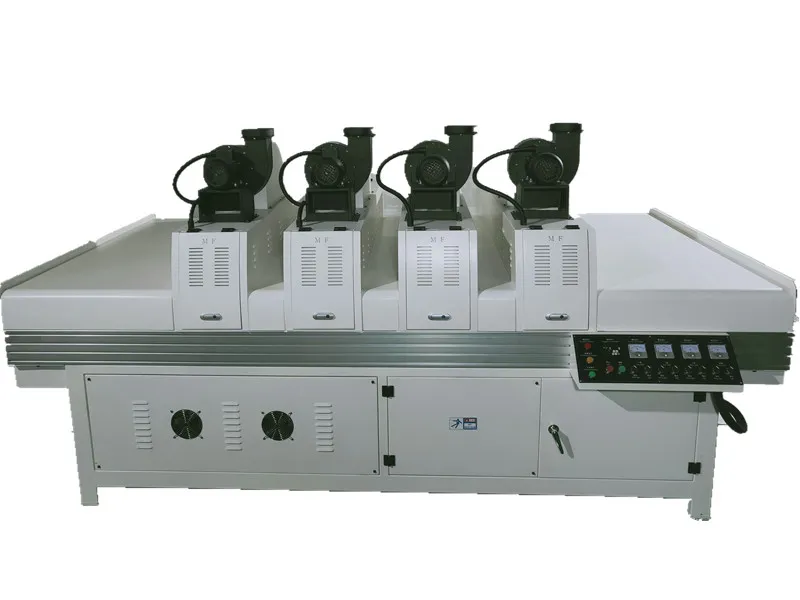
How to optimize the curing effect of thick films in a furniture UV dryer machine?
When dealing with thick paint films (over 50μm), the following techniques can be used to optimize the drying effect:
1. Multi-lamp series design
Using two to three UV lamp arrays allows for multiple superposition of light energy, improving deep curing capability.
2. Segmented curing process
First use low-energy lamps for surface drying, then use high-energy lamps for deep curing, avoiding surface shrinkage issues.
3. Increase the efficiency of the reflector system
Keep the reflector clean, or use a quartz-coated reflector to improve light utilization.
4. Control temperature and ventilation
Proper preheating can reduce paint viscosity, resulting in a more uniform paint film; simultaneously, maintain a stable cooling system to prevent overheating.
5. Adjust spectral matching
For high-viscosity thick coatings, a light source with a wavelength of 380–400nm should be selected to improve penetration.
Why do thick coatings tend to whiten?
A thick paint film results in excessive internal reflection, preventing UV light penetration. The thickness should be appropriately reduced or the light energy increased.
How to prevent surface drying followed by internal sticking?
Use segmented curing or add LED deep curing lamps.
If the paint film is too thin, how to improve fullness?
Increase the paint film thickness by applying a second coat or reducing the roller coating speed.
Can the UV lamp power be directly increased to solve the thick film problem?
Theoretically possible, but this will increase heat; the heat resistance of the substrate and ventilation must be considered.
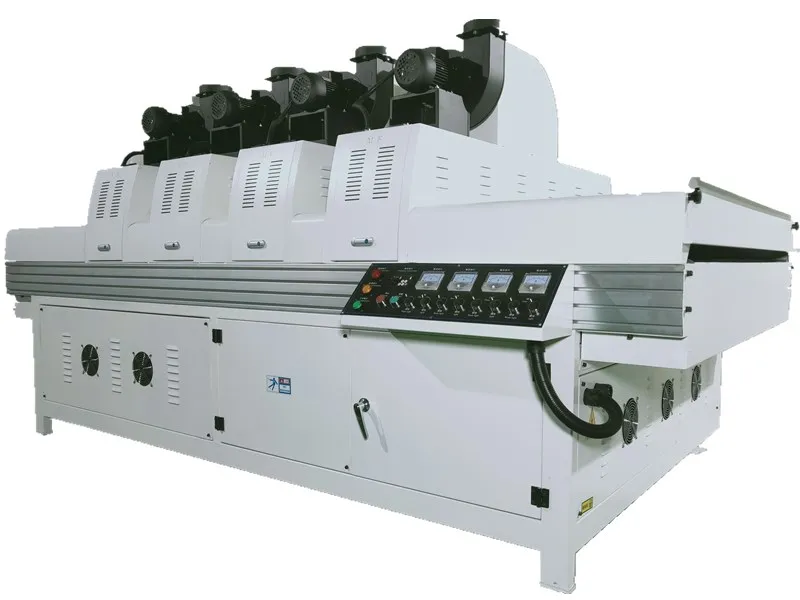
Suitable Paint Film Thickness Range for Furniture UV Dryer Machines
Based on the above analysis, we can conclude:
• The suitable paint film thickness range for furniture UV dryer machines is 5μm to 80μm.
• The optimal curing range is 15–50μm, balancing gloss, hardness, and curing efficiency.
• Thick films (>60μm) require high-power metal halide lamps or LED-395nm light sources, combined with low-speed conveyor transport.
• Thin films (<10μm) can be rapidly cured using ordinary mercury lamps or LED-365nm light sources.
• Scientifically adjusting lamp power, conveyor speed, lamp spacing, and spectral matching is key to achieving high-quality curing.
How does XMF Machinery support global customers?
XMF Machinery supplies coating and printing machines to customers worldwide, with a strong sales network in Southeast Asia, the Middle East, Africa, and other regions. As an experienced exporter and manufacturer, we understand international purchasing standards and provide professional technical communication before and after sales. Our factory offers detailed machine specifications, installation guidance, and process support to ensure smooth operation. Buyers can rely on our company for stable supply, competitive prices, and long-term cooperation.