

In the furniture manufacturing industry, surface coating is a crucial step affecting product quality, appearance, and added value. With the widespread adoption of automated equipment, UV Roller Coating Machines have become the mainstream coating equipment used by an increasing number of furniture factories. They are widely used in wooden furniture, cabinet doors, flooring, and decorative panels due to their high efficiency, high precision, energy saving, and environmental friendliness.
However, many furniture factories raise a practical question before introducing such equipment:
"How many people are needed to operate a UV Roller Coating Machine? Will it increase labor costs?"
This article will systematically analyze the operating requirements, manpower allocation principles, workflow, auxiliary positions, training needs, and efficiency influencing factors of UV Roller Coating Machines, helping furniture manufacturers clearly understand—how many people are needed to operate a UV Roller Coating Machine efficiently?

What is a UV Roller Coating Machine?
Why is it becoming increasingly popular in furniture factories?
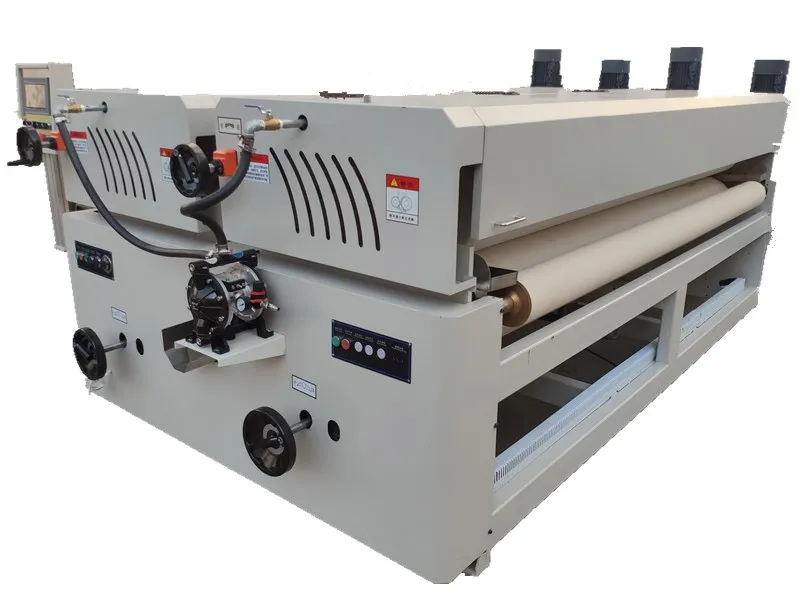
A UV Roller Coating Machine is an automated device that uses mechanical rollers to evenly apply UV-cured coatings to the surface of boards. Its main components include:
• Paint supply system: delivers UV coating to metering rollers;
• Metering system: controls coating thickness through precise roller gaps;
• Conveying system: continuously feeds the boards into the equipment;
• UV curing system: uses UV lamps to irradiate the coating, causing it to cure instantly;
• Control system: adjusts parameters such as speed, thickness, power, and temperature.
Understanding traditional spraying methods, the UV Roller Coating Machine eliminates the need for high-pressure air guns, nozzles, or drying ovens, achieving a coating utilization rate of over 90%, and offering a closed, clean, and stable production process. These characteristics have led to its widespread use in furniture factories.
What is the workflow of a UV Roller Coating Machine?
Understanding the equipment workflow helps determine the required number of personnel.
A typical UV Roller Coating Machine workflow is as follows:
1. Feeding
Place the furniture boards to be coated on the conveyor line, ensuring the surface is clean and flat.
2. Coating
The board passes between the metering roller and the coating roller, and a layer of UV paint is evenly applied to its surface.
3. UV Curing
The board enters the UV curing zone, where the coating rapidly forms a film within seconds.
4. Discharging
Curved boards are automatically output and collected manually or mechanically.
5. Cleaning & Maintenance
The rollers and pipes are cleaned regularly to maintain equipment condition and coating quality.
As can be seen from the process, the entire operation is highly automated, with most steps requiring no manual intervention. The main areas requiring human intervention are the loading and unloading stages.
How many people are typically needed to operate a UV Roller Coating Machine in a furniture factory?
This is the most crucial question.
Based on industry practice and varying levels of automation, a UV Roller Coating Machine typically requires only 2-3 operators to complete the entire production line. The following are detailed descriptions:
1. One Main Operator (Operation Controller)
Responsible for equipment startup, parameter setting, and monitoring operational status.
Main Responsibilities:
• Setting roller coating speed, UV lamp power, and coating thickness;
• Monitoring the paint supply system and curing status;
• Handling abnormal alarms and maintenance prompts.
Skill Requirements: Basic knowledge of equipment operation and understanding of coating processes.
2. One Loading Operator
Responsible for placing raw furniture boards onto the conveyor line.
Main Responsibilities:
• Checking the cleanliness of the board surface;
• Controlling the loading rhythm and direction;
• Preventing boards from jamming or colliding.
3. One Receiving Operator (Can also serve as the loading operator)
Responsible for collecting and organizing the coated boards from the discharge end.
Main Responsibilities:
• Checking if the surface quality meets requirements;
• Sorting and stacking the boards and transferring them to the next process.
In smaller furniture factories, if the production pace is moderate, feeding and unloading can be done by the same person, allowing the machine to operate stably with only two people.
However, for large production lines or high-volume production, a team of three is ideal to prevent blockages or delays.
Why does a UV Roller Coating Machine require only a few operators?
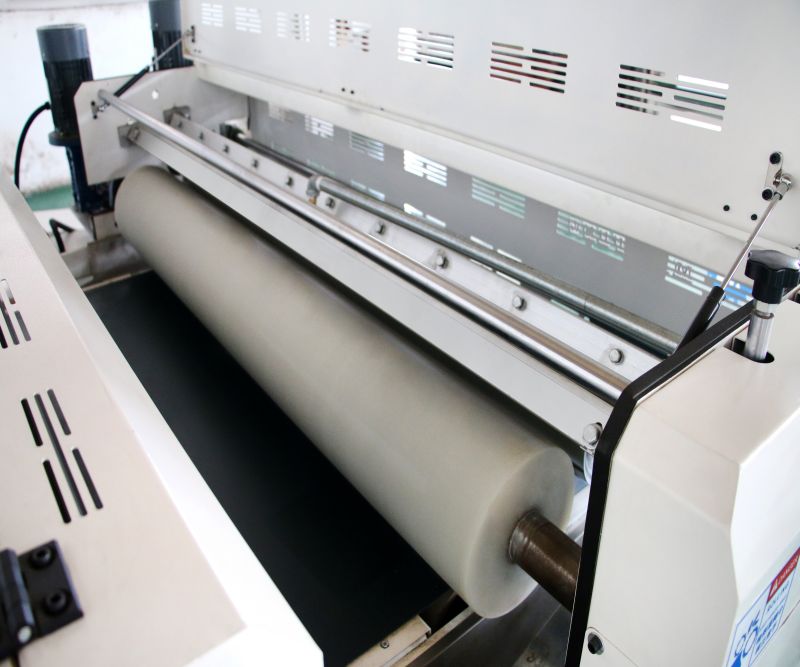
Compared to traditional methods like spray painting and curtain coating, UV Roller Coating Machines have extremely low reliance on manual labor. This stems from the following four key reasons:
1. High Automation
The machine uses a PLC control system that automatically adjusts roller speed, flow rate, and lamp power.
Operators simply select the program on the touchscreen to complete the coating process; no manual adjustments are required.
2. Continuous Paint Supply System
UV paint circulates through a closed pipeline, eliminating the need for manual addition or stirring and avoiding frequent operations.
3. Automatic Conveying and Synchronous Control
The conveyor belt can be linked with upstream and downstream processes for automatic feeding and discharging.
In some production lines equipped with automatic stacker cranes, unmanned operation is even possible.
4. Simplified Cleaning and Maintenance
The coating does not easily dry, and the equipment has a quick cleaning function, minimizing manual maintenance time.
Therefore, UV Roller Coating Machines are renowned in furniture factories for their "fewer people, higher efficiency" characteristics, reducing the number of operators by more than half compared to traditional spraying methods.
How many people are needed for a furniture factory of different sizes using a UV Roller Coating Machine?
1. Small Furniture Factory (Custom or Small Batch Production)
• Recommended Configuration: 2 people
• Job Allocation: 1 person operates the equipment, 1 person handles material loading and unloading.
• Features: Flexible, cost-effective, intermittent production possible.
2. Medium-Sized Furniture Factory (Mass Production)
• Recommended Configuration: 3 people
• Job Allocation: 1 person in charge of operation, 1 person loading, 1 person unloading.
• Features: High production continuity, high equipment utilization rate.
3. Large-scale production line (continuous flow operation)
• Recommended staffing: 4 people
• Job allocation: 1 operator, 2 material handlers, 1 material receiver.
• Characteristics: High cycle time, requires multiple people to work together to maintain the rhythm.
Regardless of scale, the labor requirements for UV Roller Coating Machines are far lower than other types of coating equipment.
What skills are required to operate a UV Roller Coating Machine?
Although the equipment is easy to operate, to achieve stable production and high-quality coatings, operators should possess the following basic abilities:
1. Understanding UV coating characteristics
Familiarity with the viscosity, temperature, and flow requirements of UV paints to avoid affecting coating results due to improper operation.
2. Mastering equipment parameter settings
Ability to select appropriate coating speed, roller gap, and lamp power according to different materials and processes.
3. Troubleshooting ability
Timely identification of problems such as abnormal paint supply, uneven coating, or insufficient curing.
4. Understanding safe operating procedures
Familiarity with UV light protection measures, equipment shutdown sequence, and emergency handling procedures.
Generally, with manufacturer training or internal technical guidance, operators can master the skills within one to two days.
How does the automation level of a UV Roller Coating Machine affect manpower allocation?
The level of automation directly determines the number of workers required. It can be categorized as follows:
Automation Types | Features | Number of operators |
| Manual/Semi-automatic | Requires manual loading and unloading, and parameter adjustment | 2-3 people |
| Standard Automatic | Automatic conveying, automatic paint supply, and intelligent curing control | 2 people |
| Integrated Line | Integrates with sanders, painting machines, and curing lines | 1 person is sufficient for monitoring |
| Intelligent Production Line | Fully automatic stacking, inspection, and cleaning system | Unattended operation is possible |
Most furniture factories use standard automatic UV Roller Coating Machines. This configuration offers the best cost-effectiveness, requiring only two operators for continuous production.
What are the advantages of UV Roller Coating Machines in terms of manpower allocation compared to manual spraying?
Let's compare the manpower requirements of the two coating methods using the same production capacity as an example:
Project | UV Roller Coating Machine | Traditional manual spraying |
| Operators | Suitable for 2-3 people | 5-6 people |
| Cleaning and preparation time | Within 10 minutes | 30 minutes or more |
| Paint utilization rate | 85%~95% | 40%-60% |
| Safety risks | Extremely low (no atomization) | Higher (involves spraying and VOCs) |
| Operating intensity | Lightweight | Heavy workload |
| Training cycle | Short duration (1-2 days) | Long working hours (skilled workers require several weeks) |
As can be seen, UV Roller Coating Machines not only save manpower but also improve overall production efficiency and environmental safety.
How can operational efficiency be further improved through reasonable division of labor?
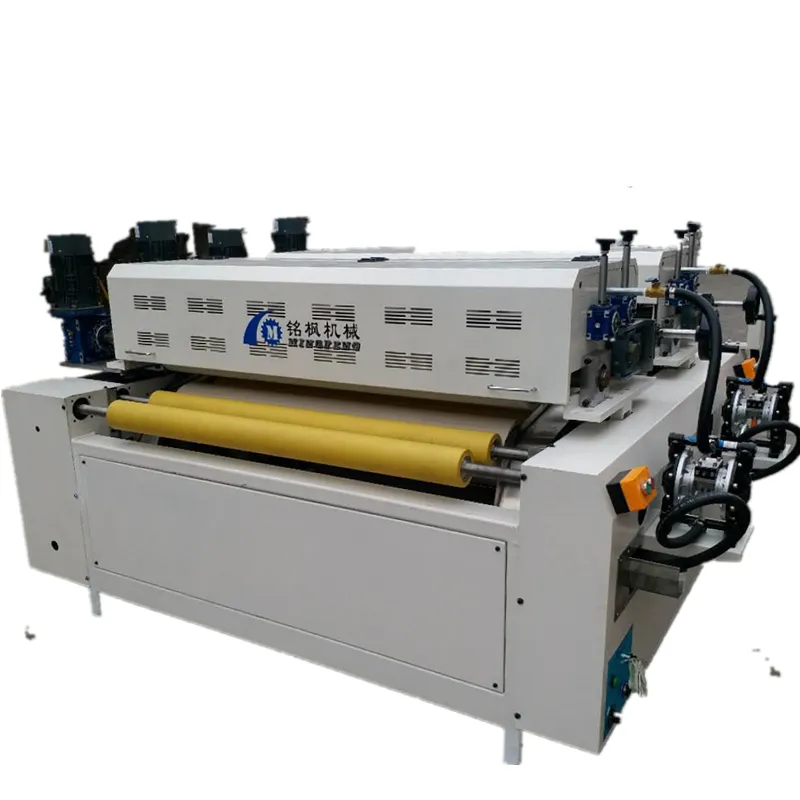
To maximize the effectiveness of UV Roller Coating Machines, furniture factories should optimize the following aspects of personnel division of labor:
• Clearly define responsibilities: Operators focus on equipment monitoring, while material handling personnel focus on logistics coordination.
• Synchronized cycle control: Ensures consistent rhythm during material feeding, coating, and receiving, preventing equipment idling.
• Cross-training: Enables material feeders to master basic operating knowledge for temporary support.
• Auxiliary positions: Allows for the addition of one quality inspector to oversee surface inspection at the output end, ensuring consistent quality.
Through optimized division of labor, small teams can achieve high-intensity continuous production.
How many people are needed to operate a UV Roller Coating Machine in a furniture factory?
✅ A UV Roller Coating Machine in a furniture factory typically requires only 2-3 people to operate efficiently.
Among them:
• 1 person responsible for equipment control and process monitoring;
• 1 person responsible for material feeding and receiving;
• Depending on production volume, one additional person can be added for assisting with handling and inspection.
This low-manpower, high-efficiency characteristic makes the UV Roller Coating Machine a key piece of equipment for modern furniture factories to achieve energy saving, cost reduction, and quality improvement.
It not only significantly reduces the intensity of manual operation, but also maintains coating consistency and improves the level of production line automation, making it an ideal choice for furniture factories pursuing efficient production and cost optimization.