
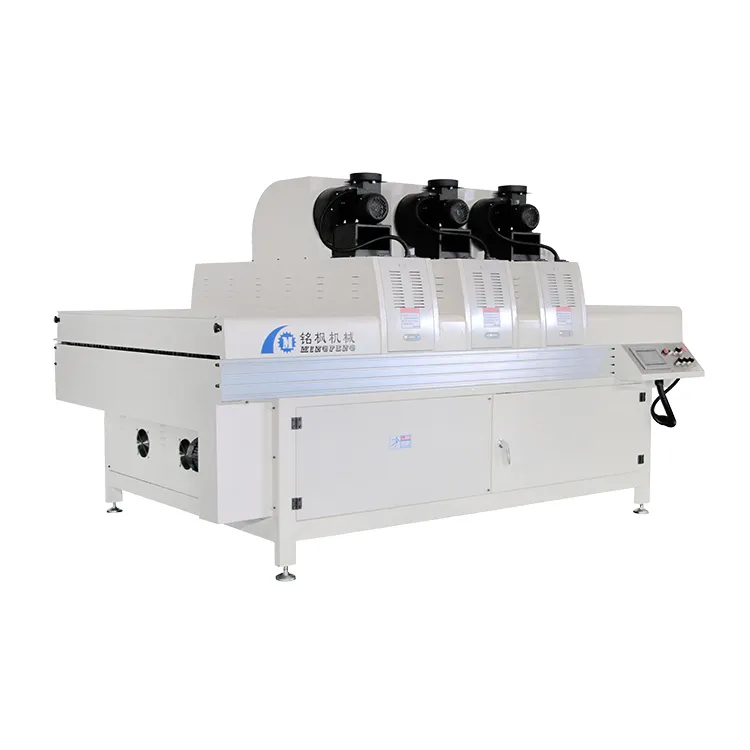
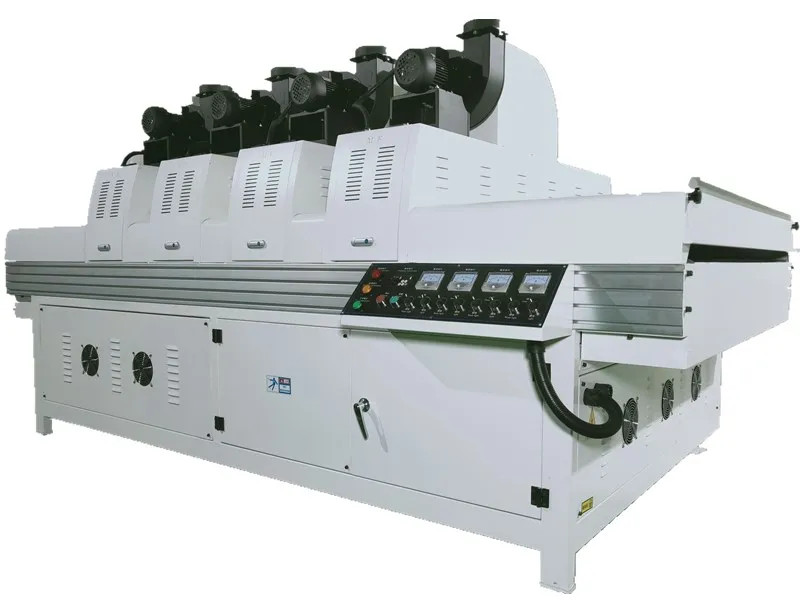
In many industries such as modern coating, printing, electronics manufacturing, and furniture coating, UV dryer machines (Ultraviolet dryers) have become an important technological means to replace traditional thermal drying equipment due to their high efficiency, environmental friendliness, and energy saving.
However, many people often encounter a technical question when using UV dryer machines: "Does the wavelength of the UV lamp affect the drying effect?"
The answer is—yes, and it has a significant impact.
This article will systematically analyze the specific impact of UV lamp wavelength on the drying effect from the perspectives of principle, wavelength classification, curing mechanism, the role of different wavelength bands, equipment matching, and wavelength control, giving you a comprehensive understanding of the core principles and application logic of UV dryer machines.
Why does the wavelength of the UV lamp affect the drying effect of a UV dryer machine?
In a UV dryer machine, drying does not rely on heat energy, but rather on ultraviolet light energy to trigger a chemical reaction in the photosensitizer (photoinitiator) in the material, thereby rapidly curing the liquid coating or ink into a film.
Ultraviolet (UV) light is an electromagnetic wave with wavelengths between 200 nm and 400 nm. Different wavelengths of UV light have different energies and penetrating power, directly determining the rate of molecular bond breaking and cross-linking in the coating.
In short: UV lamp wavelength = energy form → photoinitiator absorption efficiency → curing speed and depth.
If the wavelength is properly matched, a UV dryer machine will achieve fast drying speed, strong coating adhesion, and a smooth, glossy surface; conversely, problems such as incomplete surface drying, sticky surface, and insufficient hardness may occur.
What are the commonly used UV wavelengths in UV dryers?
To better understand the relationship between wavelength and drying effect, we first need to understand the classification of UV light.
Ultraviolet (UV) light can generally be divided into the following main bands:
Band Name | Wavelength Range (nm) | Characteristics | Role in UV Dryer Machines
UVA | 320–400 | Longest wavelength, strongest penetration | Deep curing, improves adhesion
UVB | 280–320 | Medium wavelength, relatively strong energy | Suitable for both surface and intermediate curing
UVC | 200–280 | Short wavelength, highest energy | Surface curing, rapid reaction
VUV |<200 | Ultra-short wavelength, extremely strong energy | Generally not used for curing, damages fragile materials
In UV dryer machines, UVA and UVB bands are mainly used, while UVC bands are generally only used for special industrial or sterilization applications.
What is the relationship between the wavelength and energy of a UV lamp?
The wavelength and energy of UV light are inversely proportional. The shorter the wavelength, the higher the photon energy, the stronger the effect, but the worse the penetration.
According to the physical formula: E = h·c / λ.
Where:
• E: Light energy (electron volts)
• h: Planck's constant
• c: Speed of light
• λ: Wavelength
Therefore, short-wavelength (UVC) light has higher energy and can rapidly excite molecular reactions, but it often only acts on the coating surface;
long-wavelength (UVA) light can penetrate the interior of the coating, helping to achieve deep curing.
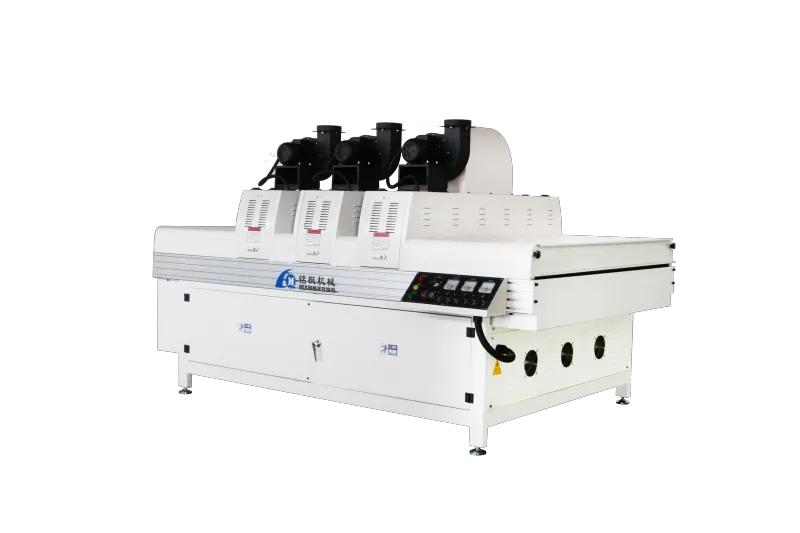
This is why high-quality UV dryer machines often use multi-band combined lamp designs.
What are the specific effects of different wavelengths on the drying effect in a UV dryer machine?
1. UVA Band: Key to Deep Curing
• Wavelength Range: 320–400nm
• Characteristics: Gentle energy, strong penetration
• Function: Can penetrate deep into the coating, allowing the film to fully cure
Application Characteristics:
• Suitable for thick coatings and dark paints;
• Helps improve paint film adhesion;
• Prevents "surface-dry, internal tack" problem.
Summary: UVA light is the fundamental wavelength for deep curing and is indispensable in a UV dryer machine.
2. UVB Band: Coordinated Curing of Surface and Intermediate Layers
• Wavelength Range: 280–320nm
• Characteristics: High energy, with both penetrating and surface-reacting capabilities.
• Function: Balances the curing speed of the surface and intermediate layers.
Application Features:
• Suitable for coatings of general thickness;
• Better results when used in conjunction with UVA;
• Effectively improves the hardness and abrasion resistance of the coating.
Summary: UVB band is often used in conjunction with UVA in UV dryer machine lamp systems to achieve balanced curing.
3. UVC Band: Rapid Surface Drying, but Not Suitable for Excessive Intensity
• Wavelength Range: 200–280nm
• Characteristics: Extremely high energy, poor penetration;
• Function: Primarily used for rapid surface curing.
Application Features:
• Suitable for thin film coatings;
• Allows for rapid surface hardening;
• However, excessive energy may cause yellowing and embrittlement of the coating.
Summary: The use of UVC light in UV dryer machines requires caution and is generally limited to specific materials or short-duration irradiation.
Wavelength Range Comparison of Commonly Used UV Lamps in UV Dryer Machines
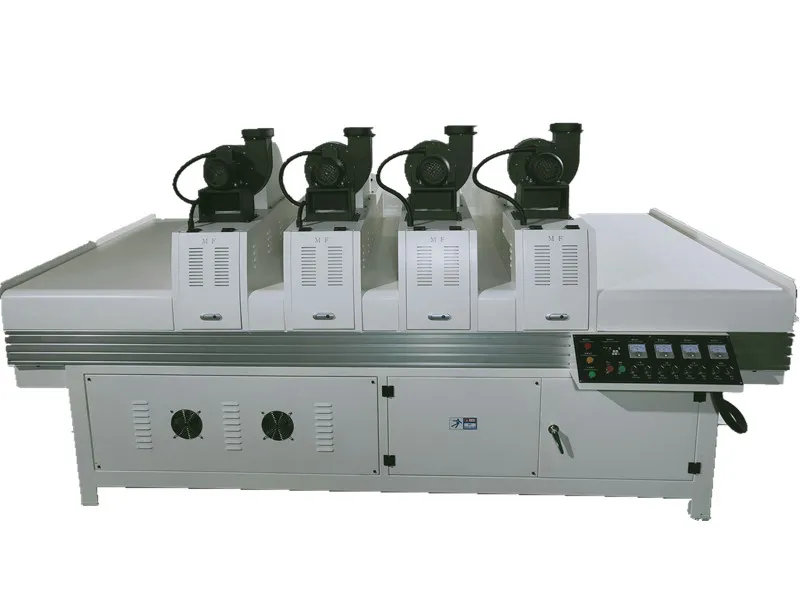
Different types of UV lamps emit different primary wavelengths, therefore, selecting the appropriate lamp type is crucial for wavelength control.
Lamp Type | Primary Wavelength Range (nm) | Main Function | Features
High-Pressure Mercury Lamp | 365 | General-purpose curing | High cost-effectiveness, wide applicability
Iron Lamp (Fe) | 380–420 | Deep curing | Strong penetration, suitable for thick films
Gallium Lamp (Ga) | 400–450 | Surface gloss | Fast surface drying, high brightness
Metal Halide Lamp | 365–450 | Full-band coverage | Broad spectrum, uniform curing
LED UV Lamp | 365 / 385 / 395 / 405 | Precise wavelength | Low-temperature, high-efficiency curing
Therefore, UV dryer machines do not rely solely on a single wavelength but achieve composite wavelength energy output through different lamp combinations to balance speed and quality.
What drying problems can improper wavelength matching cause?
If the wavelength matching of a UV dryer machine is inappropriate, even with sufficient power, it can cause various process defects.
Mismatch Situation | Possible Problems | Description
Wavelength too short (energy too high) | Surface yellowing, coating embrittlement | Surface dry but not fully dry, heat buildup
Wavelength too long (energy too low) | Incomplete curing, stickiness | Low photoinitiator absorption efficiency
Single wavelength band | Uneven drying, poor surface brightness | Insufficient deep reaction
Unbalanced lamp power | Localized stickiness, poor adhesion | Uneven coating curing
Therefore, in practical applications, UV dryer machines must adjust the light source combination and energy distribution according to the coating formulation.
Typical combinations of different wavelengths in a UV Dryer Machine
1. Single-band configuration (economical)
Uses a single mercury lamp (365nm), suitable for general UV inks or UV coatings for wood;
• Advantages: Low cost;
• Disadvantages: Poor performance on thick coatings.
2. Dual-band combination (UVA + UVB)
• Combines two types of lamps within a single UV Dryer Machine;
• Achieves simultaneous surface and internal curing;
• Commonly used for furniture coating and plastic parts varnishing.
3. Multi-band composite (UVA + UVB + UVC)
• Suitable for high-end UV curing systems;
• Allows for staged surface curing and deep curing;
• Improves overall gloss and adhesion.
4. LED UV System (Single High-Precision Band)
• Primarily uses 365nm or 395nm wavelengths;
• High curing precision and low heat generation;
• Suitable for heat-sensitive substrates.
How to test the wavelength and energy of a UV Dryer Machine?
To ensure stable drying quality, companies need to regularly test the spectral performance of their UV Dryer Machines.
1. Using a UV energy meter
Measured in mJ/cm² or mW/cm², used to monitor lamp energy output.
2. Using a Spectrometer
This allows for the determination of the actual wavelength distribution range, ensuring consistency with lamp specifications.
3. Regular Calibration and Cleaning
• Dust or paint mist on the lamp surface absorbs UV light;
• Aging of the quartz cover leads to wavelength attenuation;
• Regular cleaning and calibration maintain optimal curing energy.
Key Points for Wavelength Control in UV Dryer Machines
• Understand the characteristics of the coating system (UV paint, UV ink, UV adhesive, etc.);
• Select the lamp wavelength based on the photoinitiator absorption peak;
• Optimize the lamp combination and power;
• Keep the lamp and reflector clean;
• Regularly monitor wavelength and energy output;
• Avoid excessive irradiation that could cause thermal damage to the materials.
Only by achieving a balance between wavelength, energy, and materials can a UV Dryer Machine achieve maximum performance.
What advantages do UV dryer machines offer in modern coating lines?
UV dryer machines supplied by XMF Machinery offer fast curing speed, energy efficiency, and stable surface quality. As a professional manufacturer, we design UV curing systems that integrate smoothly with roller coating machines, printing machines, and curtain coating machines. This reduces waiting time between processes and increases overall production efficiency. Customers purchasing UV dryer machines from our factory benefit from controlled curing results and reduced labor costs.