
In modern coating production lines, curtain coating machines are widely used in industries such as wood coating, decorative panels, plastic sheets, and electronic materials due to their high efficiency, excellent coating uniformity, and suitability for large-scale continuous production.
Meanwhile, UV curing technology (ultraviolet light curing) is gradually becoming an important method for efficient and environmentally friendly coating curing.
Therefore, a question that often concerns the industry arises:
"Does a curtain coating machine need a UV curing machine?"
This article will systematically and logically analyze the compatibility, necessity, and application conditions of curtain coating machines and UV curing machines from a professional perspective, providing you with a clear technical judgment guide.
What is a curtain coating machine? What does its process principle determine?
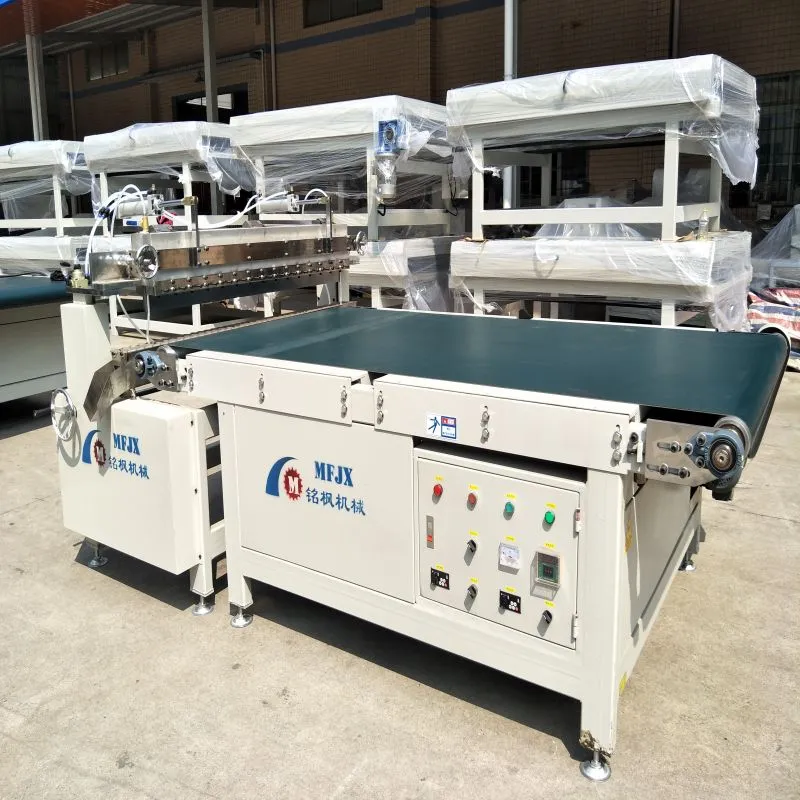
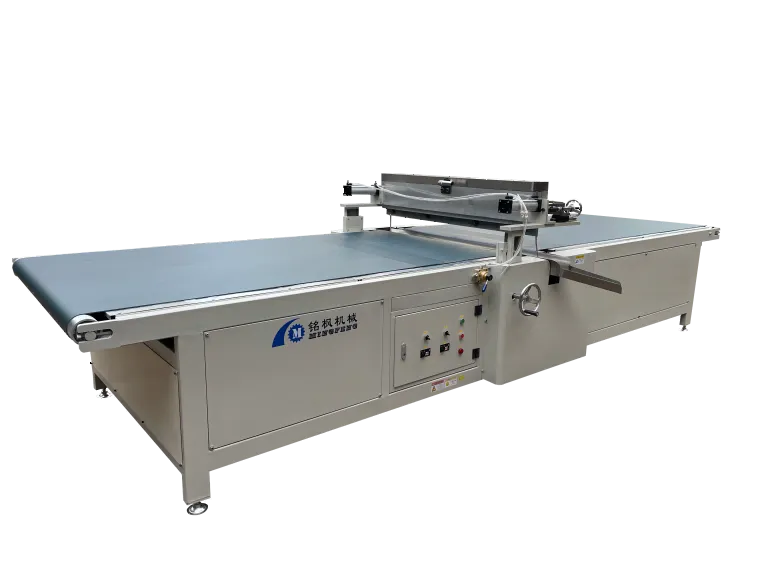
A curtain coating machine is a coating device that utilizes the free fall of liquid to form a "curtain-like fluid."
Its working principle is simple and efficient: the coating material forms a continuous liquid curtain through an overflow tank; the workpiece being coated passes through the liquid curtain area at a constant speed, the liquid evenly covering its surface, and then proceeds to subsequent stages such as leveling and curing.
Curtain coating machines typically feature the following characteristics:
• Non-contact coating, avoiding roller marks;
• Uniform coating with controllable thickness;
• Suitable for high-viscosity or high-solids-content coatings;
• High efficiency, suitable for continuous production.
However, curtain coating is only the "coating application" stage; the final properties of the coating (such as hardness, abrasion resistance, and gloss) still depend on the curing method. This is the key question regarding whether a curtain coating machine needs a UV curing machine.
Does every curtain coating machine's coating require UV curing?
Not necessarily.
Whether a curtain coating machine needs a UV curing machine depends on the coating system used.
In coating processes, common coatings mainly fall into three categories:
1. UV-curable coatings (UV coatings)
Using ultraviolet light to trigger a polymerization reaction through a photoinitiator, achieving instant curing.
2. Thermosetting coatings
Curing through heating to induce a cross-linking reaction of the resin.
3. Naturally drying (water-based or solvent-based) coatings
Drying and film formation are achieved through solvent evaporation or water evaporation.
If a curtain coating machine uses UV-curable coatings, it must be paired with a UV curing machine; if it uses thermosetting or air-drying coatings, a drying oven or natural drying line can be used.
Therefore, the relationship between a curtain coating machine and a UV curing machine is not mandatory, but depends on the physicochemical curing mechanism of the coating system.
Why are curtain coating machines often equipped with UV curing machines?
While not "essential," in practical industrial applications, curtain coating machines and UV curing machines are usually used in pairs. The reasons are as follows:
1. Fast coating curing speed
UV curing can complete curing in a very short time (usually within 1–3 seconds), which perfectly matches the high-speed, continuous production characteristics of curtain coating machines.
2. Improved surface properties
UV-cured coatings form a highly cross-linked film after exposure to light, possessing advantages such as high hardness, high gloss, and wear and scratch resistance, making them particularly suitable for products with extremely high surface quality requirements, such as wood panels, plastic panels, and decorative panels.
3. Reduced Energy Consumption and Pollution
Compared to thermosetting, UV curing eliminates the need for high-temperature drying, resulting in lower energy consumption and zero VOC emissions, meeting green production requirements.
4. Mature Integrated Equipment Design
Most industrial-grade curtain coating machines are designed with pre-installed UV curing channels or interfaces, enabling automated online operation and high production line integration.
Therefore, from the perspectives of efficiency, quality, environmental protection, and automation, curtain coating machines and UV curing machines are a natural match.
What happens if a curtain coating machine is not paired with a UV curing machine?
In certain situations, manufacturers may wish to use curtain coating machines for non-UV coatings, such as water-based or thermosetting paints. In this case, omitting a UV curing machine has the following impacts:
1. Significantly Increased Drying Time
Water-based or solvent-based coatings require air or hot air drying, a slower process. If the production cycle is fast, this can lead to buildup and surface contamination.
2. Larger Space Required
Hot air or natural drying equipment often occupies more space than UV curing machines, reducing production line compactness.
3. Limited Coating Performance
Self-drying or heat-curing coatings are generally inferior to UV-cured films in terms of hardness and abrasion resistance, making them prone to scratches or wear.
4. Environmental and Emission Issues
Soluble-based coatings release volatile organic compounds (VOCs) during the drying process, requiring a waste gas treatment system and increasing environmental costs.
Therefore, unless there are specific material or process requirements, using a curtain coating machine in conjunction with a UV curing machine offers greater economic and technical advantages.
What are the key technical points for using a curtain coating machine with a UV curing machine?
When using a curtain coating machine in conjunction with a UV curing machine, the following technical details need attention to ensure coating effectiveness:
1. Coating Viscosity and Leveling Properties
Curtain coating machines have strict requirements on coating viscosity. If the UV coating is too thick, it will affect the stability of the liquid curtain formation; if it is too thin, it may cause sagging.
Generally, it should be controlled within the range of 80–300 mPa·s to ensure a stable liquid curtain and uniform thickness.
2. Matching Coating Thickness and Curing Energy
UV curing energy is related to coating thickness. The thicker the coating, the higher the UV energy required.
Insufficient energy will result in surface curing without complete cross-linking of the underlying layer, affecting adhesion.
3. UV Lamp Power and Distance
The UV lamp power (e.g., 80–120 W/cm) and lamp distance (10–20 cm) within the curing machine should be adjusted according to the coating type.
Insufficient power will result in incomplete curing, while excessive power may cause excessive surface shrinkage.
4. Transfer Speed Control
Curtain coating machines are usually linked with curing machines. The transfer speed needs to be set comprehensively based on UV energy, coating thickness, and coating reaction rate to ensure uniform curing.
These parameter adjustments directly determine the coating quality and production efficiency after the curtain coating machine and UV curing machine work together.
Under what process conditions must a UV curing machine be used with a curtain coating machine?
In the following typical application scenarios, a UV curing machine is an essential accessory for a curtain coating machine:
• Production lines using UV-curable coatings;
• Products requiring extremely high surface hardness, gloss, and abrasion resistance;
• Continuous production modes requiring instant curing and rapid stacking and packaging;
• Temperature-sensitive substrates (such as plastics, PVC, and composite boards) that cannot be heat-cured;
• Production lines for enterprises with strict environmental requirements that need to reduce VOC emissions.
Under these conditions, the combination of a curtain coating machine and a UV curing machine is not only a necessity but also the optimal solution.
Can a curtain coating machine be used in conjunction with other curing methods?
While UV curing is the mainstream choice, curtain coating machines can also be paired with other curing methods depending on the coating system and production conditions:
Curing Method | Applicable Coatings | Advantages | Disadvantages
UV Curing | UV-cured coatings | Fast, energy-saving, environmentally friendly | Slightly higher cost, high equipment requirements
Thermosetting | Thermosetting coatings | Thorough curing, good mechanical properties | High energy consumption, slow speed
Natural Drying | Water-based or solvent-based coatings | Low cost, simple operation | Slow drying, large footprint, unstable
Infrared Curing | Special resin systems | Uniform drying, moderate efficiency | Heat-affected materials
Among these, UV curing best suits the high-efficiency characteristics of curtain coating machines, thus becoming the mainstream configuration.
What is the typical process flow for using a curtain coating machine and a UV curing machine in combination?
A typical curtain coating + UV curing production line process is as follows:
• Feeding system: Workpieces automatically enter the conveyor line;
• Curtain coating machine: Liquid curtain covers the surface, completing the coating application;
• Leveling zone: Brief pause to ensure uniform coating spread;
• UV curing machine: UV lamp irradiation achieves instant curing;
• Discharge and inspection: Finished products are dry and touchable, ready for stacking.
The entire process takes only a few seconds to tens of seconds, greatly improving production efficiency. This "coating + curing integrated" model is the biggest advantage of curtain coating machines.
Does a curtain coating machine need a UV curing machine?
From the perspective of process logic and practical application, the conclusion is very clear:
Whether a curtain coating machine needs a UV curing machine depends on the type of coating.
If UV coatings are used, a UV curing machine is mandatory.
If thermosetting or water-based coatings are used, other curing methods can be selected.
However, considering production efficiency, quality control, and environmental friendliness, using a curtain coating machine in conjunction with a UV curing machine is the most advantageous and common industrial configuration.
How does XMF Machinery control production quality?
Quality control is a core focus at XMF Machinery. As a professional manufacturer, our factory implements strict inspection procedures at every production stage, from material selection to final assembly. Machines are tested under real operating conditions to ensure performance stability and coating accuracy. Customers purchasing our equipment can trust consistent quality, long service life, and stable output.
/product-curtain-coater-machine-for-mdf-board-in-high-gloss-effct.html