

In modern industries such as surface finishing, board processing, and furniture manufacturing, coating machines are indispensable equipment within the surface treatment stage. Different types of coating machines are suited to different materials and coating requirements; among the most frequently discussed and utilized devices are the "curtain coating machine" and the "roller coating machine".
Although both are used to apply a uniform layer of coating onto the surface of boards or workpieces, they exhibit significant differences in their operating principles, applicable materials, coating thickness control, coating material characteristics, and application processes.
From a professional perspective, this article will delve deeply into the question: What is the difference between a curtain coating machine and a roller coating machine? Our aim is to help you accurately understand the process distinctions and scope of application for these two types of equipment.
What is a Curtain Coating Machine? How Does It Work?
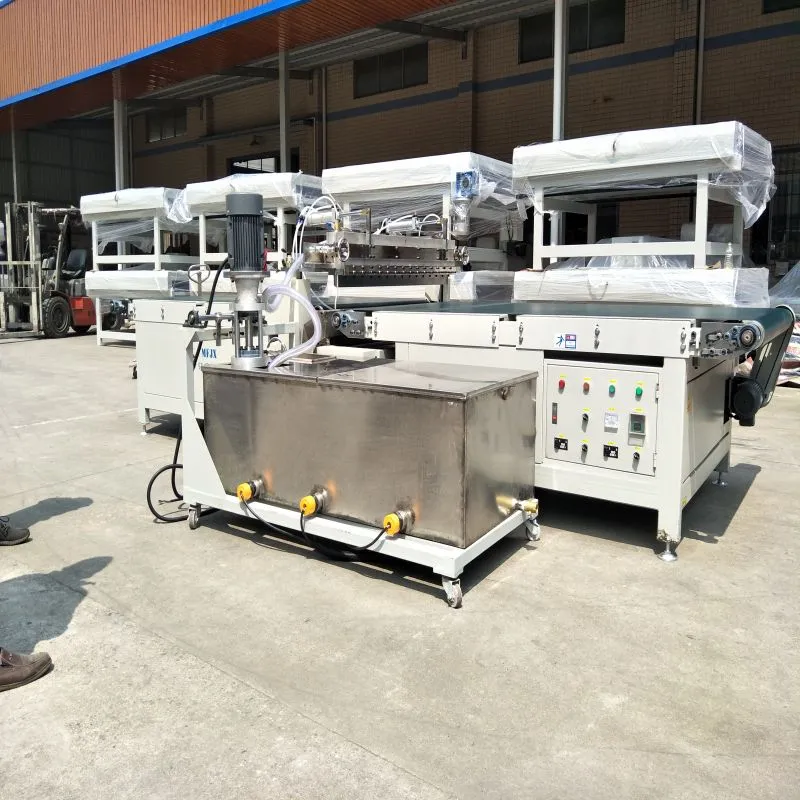
A curtain coating machine is a device that utilizes the principle of free-falling liquid flow to apply coatings. It functions by channeling liquid coating material through a specialized coating head to form a uniform "liquid curtain." As a workpiece—typically a wooden board, glass panel, plastic sheet, or metal plate—passes through this liquid curtain, the coating is applied uniformly across its surface.
1. Operating Principle
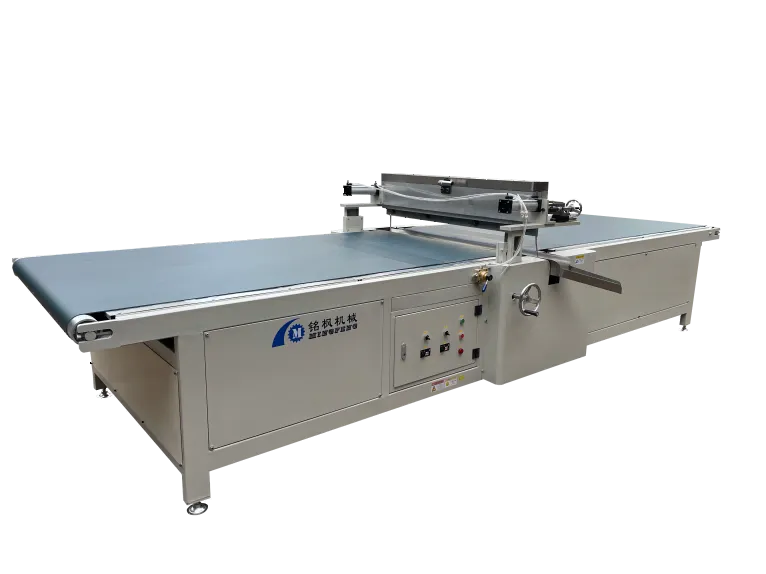
In a curtain coating machine, the coating material is first pumped to the top of a coating reservoir, where a slit-style distribution system creates a continuous "curtain" of liquid. Driven by a conveyor belt, the workpiece passes through this liquid curtain, thereby acquiring a complete, uniform, and continuous coating on its surface.
This method of coating relies on gravity and fluid viscosity; since it requires no mechanical contact, it eliminates the risk of roller marks or scratches on the workpiece surface.
2. Key Features of the Curtain Coating Machine
• Non-contact coating: Results in a uniform coating with a smooth surface finish;
• Suitable for high-gloss and thick-coating processes: Capable of forming relatively thick and level coating layers;
• High coating material recovery rate: Excess coating material can be collected and recirculated for reuse;
• High requirement for workpiece flatness: If the board surface is uneven, it may result in an inconsistent coating finish;
• Best suited for low-viscosity coating materials with good flow properties.
Consequently, curtain coating machines are frequently utilized in production lines for wooden boards, furniture panels, decorative laminates, flooring, and similar products where high standards for surface aesthetics and finish quality are required.
What is a Roller Coating Machine? So, what exactly is its coating principle?
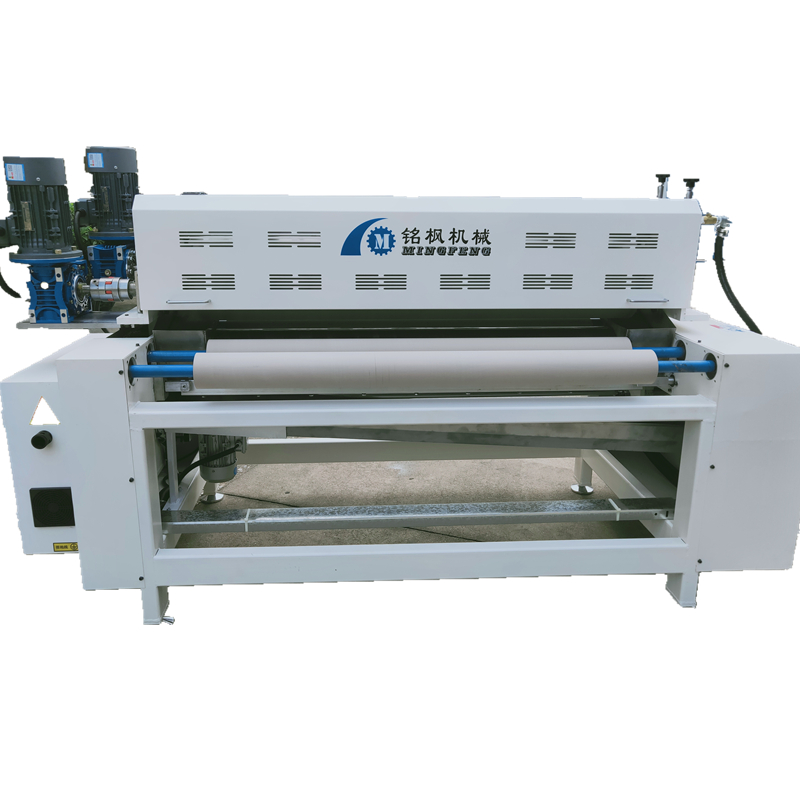
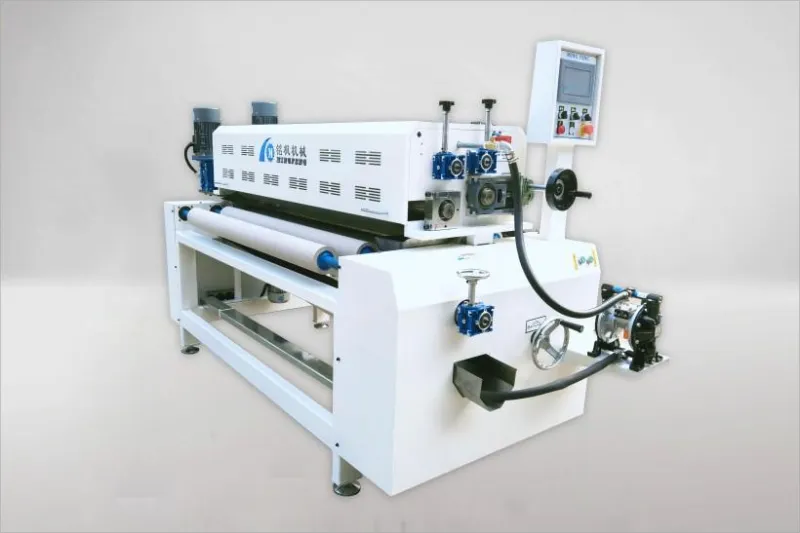
A roller coating machine is a type of coating equipment that transfers paint onto a workpiece surface through mechanical contact.
Its underlying principle involves utilizing one or more coating rollers to pick up paint from a supply tank and apply it to the material's surface at a specific pressure and speed.
1. Working Principle
The core components of a roller coating machine are the metering roller and the coating roller. The metering roller controls the thickness of the paint, while the coating roller transfers the paint onto the workpiece surface. By adjusting the gap between the two rollers, their differential rotational speeds, and the paint's viscosity, the coating thickness and uniformity can be precisely controlled.
Some roller coating machines are also equipped with additional systems—such as infrared preheating, doctor blade leveling, and UV curing—to form a complete, integrated coating production line.
2. Key Features of Roller Coating Machines
• High coating precision and controllable thickness;
• Compact equipment structure and stable operation;
• Suitable for high-viscosity or medium-viscosity paints;
• Applicable to various board surfaces, including wood, plastics, metals, paper, etc.;
• Enables efficient, continuous production.
Consequently, roller coating machines are widely used in industries such as furniture, door panels, flooring, decorative panels, and construction materials for the application of primers, intermediate coats, or topcoats.
How does the working principle of a curtain coating machine differ from that of a roller coating machine?
The primary difference between the two lies in the method by which the paint makes contact with the workpiece:
Comparison Item | Curtain Coating Machine | Roller Coating Machine
Coating Method | Paint free-falls to form a liquid curtain | Coating roller transfers paint via mechanical contact
Paint-to-Workpiece Contact | Non-contact (coverage via liquid flow) | Mechanical contact (rolling pressure application)
Coating Uniformity | Highly uniform and level | Uniformity depends on roller pressure and speed
Suitable Paint Types | Low-viscosity, high-fluidity paints | Medium-to-high viscosity paints with good thixotropy
Coating Thickness | Generally thicker (60–200 μm) | Wide controllable range (10–100 μm)
As is evident, the curtain coating machine places greater emphasis on the continuity of fluid coverage, whereas the roller coating machine prioritizes mechanical metering and precise thickness control.
Curtain Coating Machines vs. Roller Coating Machines: What are the differences in coating effects?
1. Coating Flatness and Gloss
Due to its use of a flowing liquid curtain, the curtain coating machine achieves extremely high levels of coating flatness and gloss; it is particularly well-suited for producing panels with high-gloss surfaces or mirror-like finishes.
While the roller coating machine can achieve uniform application, mechanical contact may result in minute surface textures or roller marks; it is therefore more suitable for primer and intermediate coating processes.
2. Coating Thickness Control
The roller coating machine allows for precise adjustment of coating thickness via a metering roller, making it suitable for production processes that demand strict control. Although the curtain coating machine can apply thicker coatings, thickness adjustment relies on factors such as liquid flow rate, viscosity, and conveyor speed, making the control process slightly more complex.
3. Suitability for Workpiece Surfaces
The curtain coating machine requires the workpiece surface to be absolutely flat; otherwise, issues such as paint sagging or pooling may occur. The roller coating machine, conversely, demonstrates a certain degree of adaptability to slightly uneven surfaces.
How do the types of applicable coatings differ between curtain coating machines and roller coating machines?
Coating Category | Curtain Coating Machine | Roller Coating Machine
UV Coatings | ✔ Suitable (Low-viscosity UV paints) | ✔ Suitable (Medium-to-high viscosity UV paints)
Solvent-based Coatings | ✔ Usable (but requires flow rate control) | ✔ Commonly used
Water-based Coatings | ✔ High demands on rheological properties | ✔ Highly adaptable
Thick-film Coatings | ✔ More suitable | ✘ Not suitable
Primers | Usable | Highly suitable
Topcoats | Best results for high-gloss topcoats | Suitable for matte topcoats
In summary, the curtain coating machine is best suited for low-viscosity topcoats with excellent self-leveling properties, whereas the roller coating machine is ideal for primers and intermediate coatings that require precise control and consistent thickness.
Curtain Coating Machines vs. Roller Coating Machines: What are the differences in energy consumption and efficiency?
• Curtain Coating Machine: Since the coating material relies on gravity for application, overall energy consumption is relatively low; however, the liquid circulation system and pumps operate continuously, placing high demands on the flow properties of the coating material. This equipment is typically suited for processes involving large coating volumes and thick-film applications, offering high coverage rates in a single pass.
• Roller Coating Machine: Relies on a motor-driven roller shaft for rotation; while its mechanical energy consumption is relatively higher, it offers excellent production efficiency, stable continuous operation, and high paint utilization.
Overall, the roller coating machine is more efficient for mass production, whereas the curtain coating machine is better suited for products requiring high-quality surface finishes and thick coatings.
What are the advantages and disadvantages of the curtain coating machine?
Advantages of the Curtain Coating Machine:
• Produces a continuous coating with high surface flatness;
• Suitable for thick coatings and high-gloss finishes;
• Compatible with various low-viscosity coatings, such as UV and PU;
• High paint recirculation rate, resulting in minimal waste;
• No mechanical contact with the surface, thereby reducing the risk of scratches.
Disadvantages of the Curtain Coating Machine:
• Requires a high degree of flatness in the substrate surface;
• Complex control of paint viscosity and flow rate;
• Unsuitable for small-sized or irregularly shaped workpieces;
• High initial equipment investment cost;
• Changing paint types and cleaning the machine can be cumbersome.
What are the advantages and disadvantages of the roller coating machine?
Advantages of the Roller Coating Machine:
• Precise and controllable coating thickness;
• Wide scope of application and strong compatibility with various workpieces;
• Allows for rapid switching between different paint types;
• Simple to operate and easy to maintain;
• Ideal for continuous production lines.
Disadvantages of the Roller Coating Machine:
• Requires a relatively high degree of surface flatness in the substrate;
• Contact between the roller and the substrate surface may result in pressure marks;
• Unsuitable for thick coatings or topcoats requiring extremely high gloss levels;
• Rollers require periodic replacement or repair as they wear down.
What are the differences in application areas between the curtain coating machine and the roller coating machine?
Application Industry | Curtain Coating Machine | Roller Coating Machine
Furniture Industry | ✔ High-gloss furniture panels | ✔ Wooden doors, primer layers
Flooring Manufacturing | ✔ Protective topcoats | ✔ Primer/sealing coats
Architectural Decorative Panels | ✔ High-flatness decorative finishes | ✔ General decorative coatings
Plastic/Metal Parts | ✔ Small-batch, high-quality surfaces | ✔ Mass production with uniform coating
UV Curing Processes | ✔ High-gloss UV topcoats | ✔ Base-layer UV primers
As is evident, the curtain coating machine leans more toward high-end decorative surface applications, whereas the roller coating machine offers a broader scope of coverage and serves as foundational equipment for most coating production lines.