

In the modern furniture manufacturing industry, the curing speed and quality of surface coatings determine the efficiency of the production line and the quality of the finished product. With the popularization of UV coating technology, furniture UV dryer machines have become indispensable equipment on furniture production lines. They can cure UV coatings in a very short time through ultraviolet irradiation, significantly improving production efficiency.
However, many users raise a key question in production practice: Can furniture UV dryer machines control curing time?
This question seems simple, but it involves various process parameters such as UV irradiation energy, lamp type, conveyor speed, and coating thickness.
This article will systematically and deeply analyze the principles, methods, influencing factors, and optimization strategies for curing time control in furniture UV dryer machines, helping readers fully understand the adjustability and application rules of the equipment.
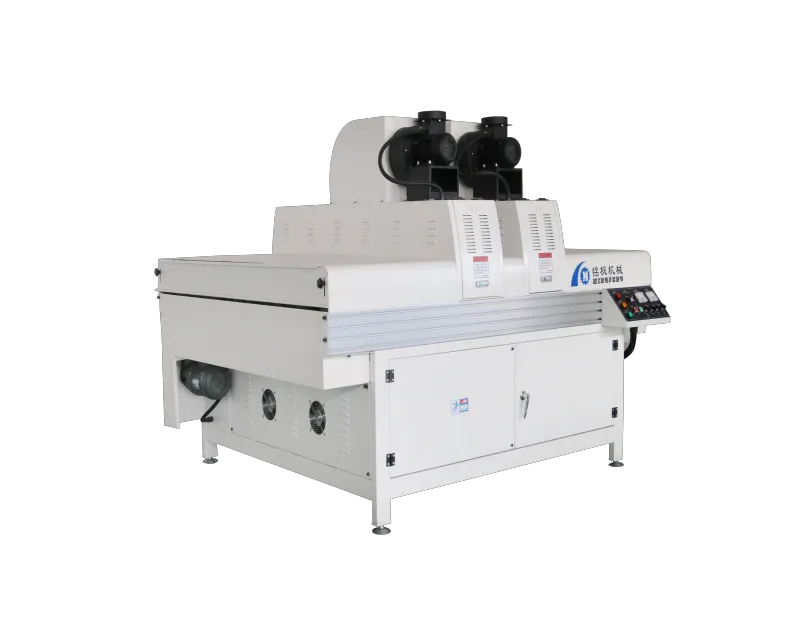
What is a furniture UV dryer machine? Why is curing time so important?
A furniture UV dryer machine is a device that uses ultraviolet (UV) radiation to rapidly cure UV coatings containing photoinitiators. Unlike traditional hot air dryers, UV drying does not rely on high-temperature heating. Instead, it uses high-energy UV light to activate photoinitiators in the coating molecules, instantly completing the cross-linking reaction and forming a hard paint film.
The main advantages of UV drying technology include:
• Fast curing speed: Surface drying is achieved within seconds;
• Low energy consumption: No need for prolonged heating;
• High-quality paint film: Smooth surface, high hardness, and strong abrasion resistance;
• High production efficiency: Enables continuous production line operation.
In furniture coating processes, curing time control is crucial for ensuring paint film quality and production cycle time.
If the curing time is too short, the paint film may not be fully cured; if the time is too long, it will result in increased energy consumption or an overly hard paint film with reduced adhesion.
Therefore, understanding and mastering the curing time control principle of furniture UV dryers is a core element in optimizing production efficiency and product quality.
What is the curing principle of furniture UV dryers?
When the UV light emitted by the lamps of a furniture UV dryer shines on the UV coating, the photoinitiator in the coating absorbs the light energy and generates free radicals or cations, which in turn initiates resin cross-linking polymerization, causing the coating to cure rapidly.
The curing time actually depends on whether the UV energy density (mJ/cm²) reaches the reaction threshold required by the coating system.
The key parameters affecting energy density are:
1. Lamp power (W/cm²)
Higher power results in greater light intensity and shorter curing time.
2. Number and arrangement of light sources
Multi-lamp array designs improve light uniformity and accelerate curing.
3. Conveyor speed (m/min)
Faster conveyor speeds result in shorter exposure time to UV light on the workpiece.
4. Distance between light source and workpiece
Closer distances result in more concentrated light energy and shorter curing time.
5. Coating thickness and formulation
Thicker films require higher energy irradiation, thus requiring longer curing times.
Therefore, in principle, the curing time of a furniture UV dryer machine can be controlled, but this control is not achieved by "directly setting the time," but rather by adjusting parameters such as light intensity and speed.
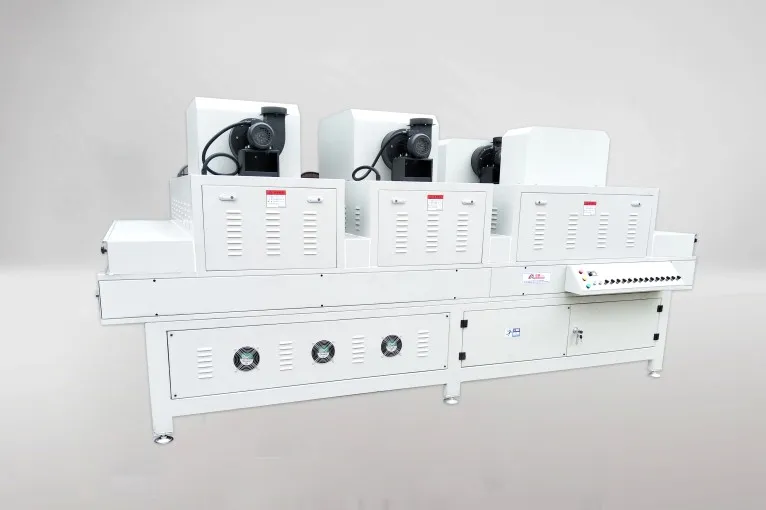
How can the curing time of a furniture UV dryer machine be controlled?
1. Controlling curing time by adjusting conveyor speed
Conveyor speed is the most direct adjustable parameter.
• High speed → Short curing time → Insufficient energy, potentially incomplete curing;
• Slow speed → Long curing time → Sufficient energy, but may result in an overly hard paint film.
For example, if the UV lamp power is fixed at 120W/cm, when the conveyor belt speed decreases from 8m/min to 4m/min, the curing energy doubles, significantly extending the curing time and ensuring sufficient reaction.
2. Controlling curing time by adjusting lamp power
Most furniture UV dryers are equipped with an adjustable power lamp source control system, allowing you to set the UV output intensity according to different processes.
The common adjustment range is 30%–100% output power.
For example, topcoats typically require higher energy (100% power), while primers or intermediate coats can use lower energy (60–80%) to prevent the surface from becoming too hard and reducing adhesion.
3. Change the number of lamps or the lighting mode
Some furniture UV dryers have multi-lamp modules, such as "dual-lamp" or "triple-lamp arrays."
Users can choose to turn on different numbers of lamps to change the total light energy:
• Single-lamp operation → Suitable for thin-layer coatings;
• Dual-lamp operation → For medium-thickness curing;
• Triple-lamp operation → For high-solids-content thick-film curing.
By controlling the number of lamps, the curing energy and time can be flexibly adjusted.
4. Adjust the distance between the lamp and the workpiece
If the UV light source is too far from the workpiece, the light intensity will attenuate significantly, and the curing time will be prolonged.
The ideal distance is generally maintained at 80–120mm.
Adjusting the lamp height is one of the important means of fine-tuning the curing time.
5. Controlled by Energy Detection Feedback System
High-end furniture UV dryers are typically equipped with a UV energy detection and closed-loop control system.
When light intensity attenuation is detected, the system automatically adjusts the lamp power or speed to ensure that each piece of furniture receives the same energy irradiation, thus achieving a constant curing time.
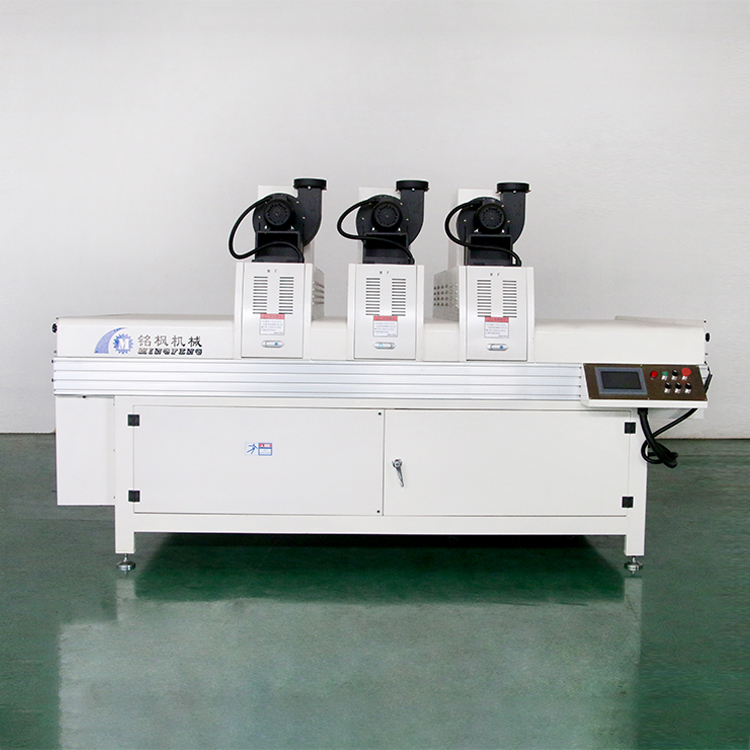
What is the typical curing time for a furniture UV dryer?
Curing time is not an absolute value, but depends on the type of coating, the power of the light source, and the equipment parameters.
The following is a typical curing time reference for UV dryers in common furniture coating processes:
Coating Type | Film Thickness (μm) | Lamp Power (W/cm) | Curing Time (seconds) | Conveyor Speed (m/min)
UV Primer | 30–50 | 80–120 | 3–5 | 8–12
UV Intermediate Coat | 20–40 | 100–140 | 2–4 | 10–15
UV Topcoat | 10–25 | 120–160 | 1–3 | 15–20
High-Gloss UV Topcoat | 15–30 | 160 | 1–2 | 18–25
As can be seen from the table, the curing time of a furniture UV dryer is typically between 1 and 5 seconds, but can be freely controlled within a reasonable range by adjusting the equipment parameters.
Why is it necessary to control the curing time?
Curving time directly affects the physical and chemical properties of the coating film.
Improper control can lead to various quality problems:
1. Effects of Insufficient Curing Time:
• Incomplete surface drying, resulting in a sticky surface;
• Insufficient paint film adhesion, leading to easy peeling;
• Uneven gloss, surface haze;
• Difficulty in subsequent coating adhesion.
2. Effects of Excessive Curing Time:
• Overly hard paint film, lacking flexibility;
• Incomplete cross-linking of inner layers, prone to cracking;
• Excessive energy consumption, reducing production efficiency;
• Surface may yellow or lose gloss.
Therefore, scientifically controlling curing time is crucial to ensuring furniture coating quality and production rhythm.
What factors can cause curing time deviations?
Even when running on the same furniture UV dryer machine, curing times may vary between different batches of products. The main reasons include:
1. Lamp Aging
After prolonged use, the UV output intensity decreases, leading to extended curing time. It is generally recommended to replace lamps after 800–1000 hours of use.
2. Lampshade or Quartz Glass Contamination
Dust, paint mist, or oil stains absorb ultraviolet light, reducing effective irradiation energy.
The light path system should be cleaned regularly.
3. Ambient Temperature and Humidity Variations
Excessively low temperature or high humidity can affect the coating reaction rate, indirectly altering the curing time.
4. Coating Formulation Differences
Different brands or models of UV coatings have different photoinitiator response wavelengths and reaction rates, thus affecting curing time.
5. Workpiece Surface Reflectivity
Dark-colored, matte materials absorb light strongly, resulting in reduced effective energy and requiring a correspondingly longer curing time.
How to Scientifically Set the Curing Time of a Furniture UV Dryer Machine?
To ensure stable coating quality, the following steps should be followed to determine a reasonable curing time:
1. Measure Energy Output Using a UV Energy Meter
Determine the energy required by the coating system (mJ/cm²) and measure the actual output value of the UV dryer machine.
2. Adjust Speed and Power to a Matching State
Through multiple experiments, find the optimal combination that achieves complete curing without wasting energy.
3. Record Process Parameters
Save parameter schemes for different processes in the equipment control system for easy and quick switching.
4. Regularly Inspect and Calibrate the Equipment
Inspect light intensity and calibrate the speed sensor to prevent parameter drift.
5. Employ Automatic Energy Compensation
If the equipment supports closed-loop control, enabling the automatic compensation function ensures consistent curing time each time.
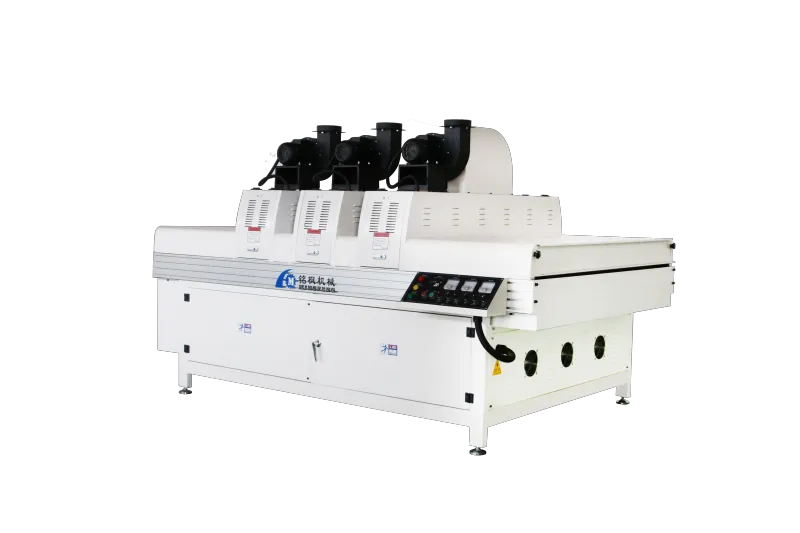
Can a furniture UV dryer machine achieve automatic curing time control?
The answer is yes.
Modern furniture UV dryers are typically equipped with a PLC intelligent control system, which can achieve the following functions:
• Automatically set the conveyor speed according to different processes;
• Automatically adjust lamp power;
• Real-time detection of UV energy and feedback correction;
• Record historical curing data to ensure consistency.
In this intelligent mode, the operator only needs to select the process program, and the equipment will automatically control the curing time and energy, thereby ensuring stable coating curing quality for each piece of furniture.
Key Measures to Extend Equipment Lifespan and Maintain Curing Stability
To ensure that your furniture UV dryer machine maintains stable curing times and performance over the long term, pay attention to the following maintenance points:
• Replace lamps and ballasts regularly;
• Clean the quartz protective glass and reflector;
• Check the cooling system to prevent overheating;
• Calibrate the conveyor speed quarterly;
• Record UV energy decay trends and adjust parameters promptly.
Good maintenance not only ensures consistent curing times but also extends equipment lifespan and reduces energy consumption.