

In the field of modern coating technology, "high gloss" has become an important indicator for measuring the surface quality of products. Whether in packaging materials, optical films, home décor panels, or functional coatings, surface gloss not only directly affects the visual effect of products but also relates to their added value and market competitiveness.
Among various coating processes, curtain coating machines, due to their advantages of good uniformity, high speed, and ability to achieve high-precision coatings, have gradually become one of the important types of equipment for achieving high-gloss effects.
But the question is—can curtain coating machines really achieve high-gloss effects?
The answer is: yes, and under specific conditions, high-gloss curtain coating machines can achieve a mirror-like high-gloss effect that surpasses traditional roller and blade coating processes.
This article will systematically analyze how high-gloss curtain coating machines achieve high-gloss effects from multiple perspectives, including technical principles, coating conditions, equipment structure, and operating parameters.
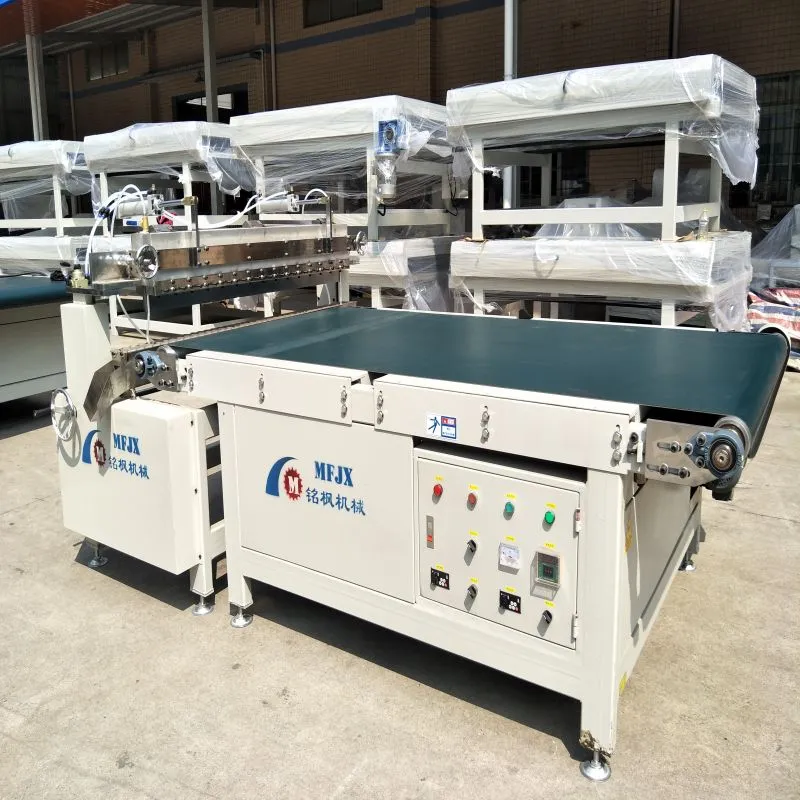
What is a curtain coater? What is its relationship to high gloss?
A curtain coating machine is a device that uses a free-falling liquid curtain to uniformly deposit coating liquid onto the surface of a substrate. Unlike traditional roller coating, curtain coating machines do not rely on direct contact application. Instead, they utilize the surface tension and gravity of the liquid to form a continuous liquid curtain, achieving high-speed, uniform, and non-contact coating coverage.
This non-contact coating method is the key foundation for achieving a high-gloss effect. The reasons are as follows:
1. No mechanical contact, preserving surface smoothness
Roller coating can cause localized indentations due to roller pressure or doctor blade force. Curtain coating machines, through liquid curtain deposition, avoid mechanical friction marks, resulting in a smoother, more uniform coating surface.
2. High coating thickness uniformity
The liquid curtain has a natural "self-leveling" property. Combined with a precise flow control system, it ensures that coating thickness errors are within a minimal range, which is crucial for achieving a high-gloss surface.
3. Surface tension-driven mirror leveling
Before the liquid solidifies, intermolecular forces cause the surface to tend towards a minimum energy state, forming a mirror-smooth coating structure. This characteristic determines that curtain coating machines possess the physical conditions to achieve a "mirror-like" finish.
Therefore, from a technical standpoint, a high-gloss curtain coater possesses the fundamental technology to achieve a high-gloss effect.
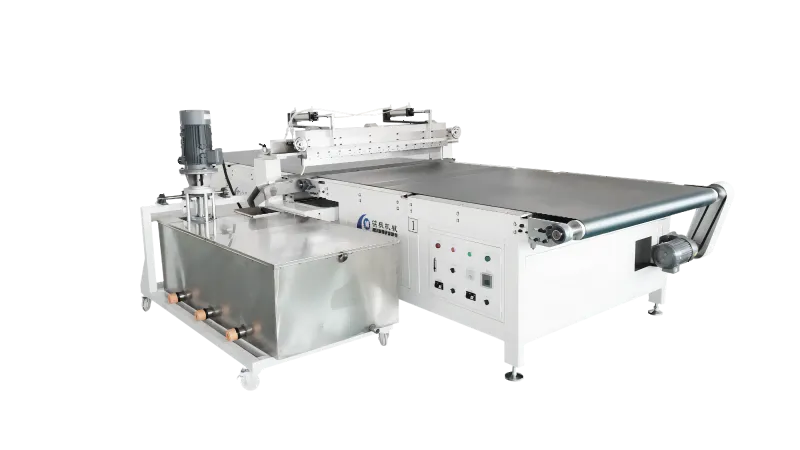
What is the principle behind the formation of a high-gloss effect?
To understand how a high-gloss curtain coater achieves a high-gloss effect, we must first understand the physical mechanism of "gloss." Surface gloss primarily depends on two factors:
1. Surface smoothness (microscopic roughness)
The smoother the coating surface and the lower the microscopic roughness, the more specular the reflection of incident light tends to be, resulting in higher gloss.
2. Optical properties of the coating (refractive index and transparency)
Coating materials with high refractive index and low scattering enhance the reflective effect, making the surface appear brighter.
Therefore, the key to achieving a high-gloss effect with a high-gloss curtain coater lies in the leveling properties of the coating and the control of film formation quality. This is not only related to the equipment structure but also closely related to fluid dynamics, interfacial tension, and drying and curing conditions.
How does a high-gloss curtain coater achieve a specular gloss?
1. Liquid Curtain Stability is Key
The stability of the liquid curtain directly determines the uniformity of the coating surface. Instability or fluctuations in the liquid curtain can lead to uneven thickness or bubble defects, thus affecting gloss.
High-gloss curtain coating machines typically feature the following structures to ensure liquid curtain stability:
• Precision overflow channel design: ensures uniform liquid distribution along the wide width;
• Constant pressure liquid supply system: ensures flow fluctuations are less than 1% through closed-loop control;
• Air knife and edge control: prevent edge liquid curtain breakage or air entrapment.
Through these control measures, the liquid curtain can remain stable during high-speed operation, thus achieving the prerequisite for surface leveling.
2. The Influence of Coating Rheological Properties on Gloss
High-gloss coatings require coatings with good leveling properties, but excessive flow can lead to sagging or layer mixing.
High-gloss curtain coating machines are generally suitable for medium viscosity (200–1500 mPa·s) coating systems. Key parameters include:
• Surface tension: Affects the spread and leveling of the liquid curtain;
• Viscosity and shear thinning: Determine the uniformity of coating flow under liquid curtain conditions;
• Curing rate: Excessive curing can lead to surface freezing and reduced gloss.
By properly adjusting these physical properties, the coating can be fully leveled before curing, forming a smooth mirror surface, thus achieving a high-gloss effect.
3. Control of Drying and Curing Conditions
After coating, the drying and curing process plays a decisive role in the final gloss level.
High-gloss curtain coating machines are usually used in conjunction with multi-stage drying systems or UV curing systems to ensure a balance between surface tension and solvent evaporation rate during film formation. Key points include:
• Stepwise temperature increase drying: Prevents premature surface curing leading to the "orange peel effect";
• Control of airflow direction and speed: Avoids disturbing uncured surfaces;
• Simultaneous UV/EB curing control: Ensures simultaneous curing of the surface and interior, forming a dense film layer.
Only when drying or curing is uniform and stable can a consistently high gloss level be achieved.
What factors affect the high-gloss effect of a curtain coater?
Even with a high-gloss curtain coater, improper process control can still lead to insufficient gloss or surface defects.
The following are factors affecting the gloss effect of a curtain coater:
1. Substrate Surface Condition
If the substrate surface is rough or contains dust, the coating will be difficult to form a mirror finish. The substrate must be clean and smooth.
2. Environmental Control
Temperature, humidity, and cleanliness affect leveling and drying speed. High-gloss coating is usually performed in a clean environment with constant temperature and humidity.
3. Coating Formulation
Different solvent systems, resin types, and additives have a significant impact on surface tension and refractive index, directly determining gloss.
4. Coating Parameter Settings
These include curtain height, flow rate, speed, and winding tension. Fine-tuning these parameters can maximize the gloss effect of the high-gloss curtain coating machine.
5. Drying and Curing Matching
If the drying rate and leveling time are mismatched, surface ripples or pinholes will appear, reducing gloss.
Therefore, achieving a stable high-gloss effect requires systematic control over equipment, materials, and processes.
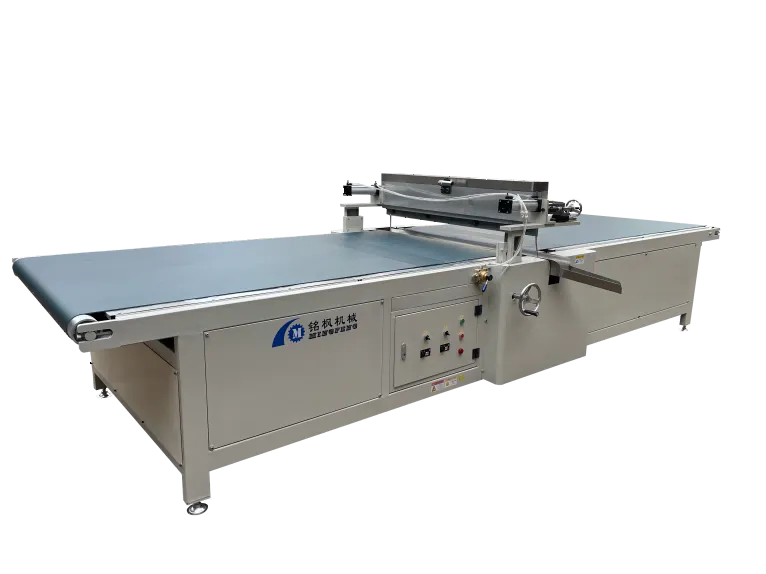
What types of coatings are suitable for high-gloss curtain coating machines?
High-gloss curtain coating machines are widely used in the production of functional films, protective films, and decorative materials requiring a glossy surface, including but not limited to:
• Coating of plastic films such as PET, BOPP, and PVC;
• High-gloss surfaces of wood panels and furniture decorative paper;
• Optical films, anti-glare films, and hardening films;
• Packaging materials (such as high-gloss cardboard and label films);
• High-precision applications such as battery separators and functional coating films.
These applications share the common characteristic of requiring extremely high surface gloss, smoothness, and uniformity, making curtain coating machines an ideal choice.
How to determine if a curtain coater possesses high-gloss capabilities?
When selecting a high-gloss curtain coating machine, the following technical indicators can be used to determine its ability to achieve a high-gloss effect:
• Flow control accuracy: Error should be less than ±1%;
• Liquid curtain width uniformity: Thickness difference should not exceed ±2%;
• Liquid curtain stability (time without fluctuation): Sustained >30 minutes;
• Coating thickness uniformity: ≤±0.5 μm;
• Gloss (measured at 60°): Should be ≥95 GU;
• System cleanliness and anti-bubble design: Effectively avoids surface particles and pores.
These performance parameters comprehensively reflect the equipment's potential in achieving a high-gloss effect.
Can a high-gloss curtain coater replace other high-gloss coating methods?
From a technical perspective, a high-gloss curtain coating machine can indeed replace traditional methods such as roller coating and spraying in many scenarios, especially in large-area continuous coating production requiring high gloss and high uniformity. However, it's also necessary to consider the material characteristics:
• If the substrate is highly absorbent (such as paper), a primer or pretreatment may be required;
• If the coating has an extremely short curing time, the liquid curtain height and speed need to be adjusted;
• If a localized high-gloss pattern is required, a curtain coating machine is unsuitable; digital spraying or screen printing should be used instead.
Therefore, curtain coating machines are more suitable for producing large-area continuous high-gloss coatings than for localized finishing.
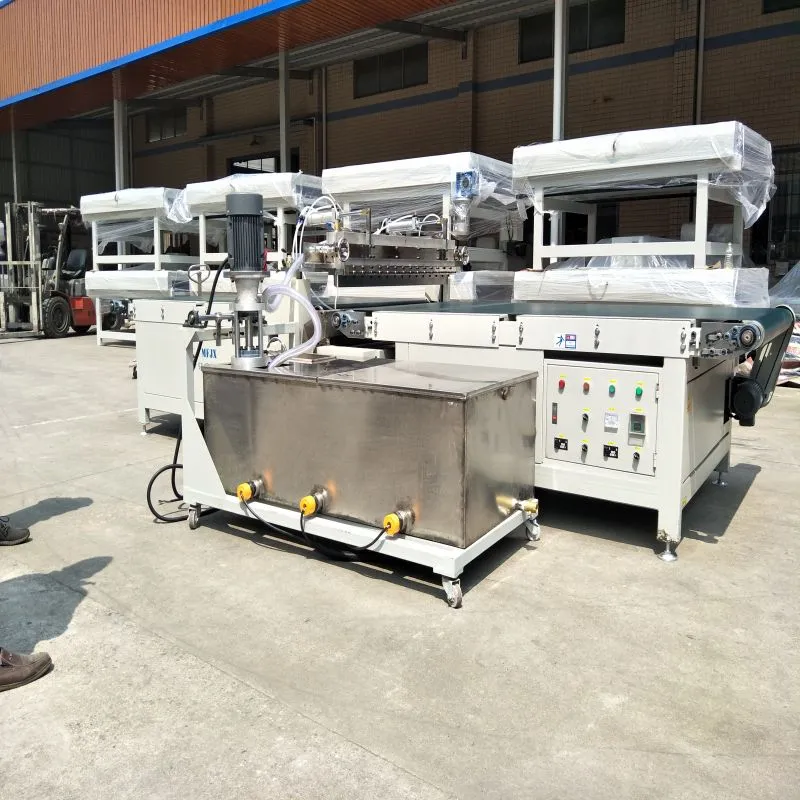
Can a curtain coating machine achieve a high-gloss effect?
The answer is yes.
With its unique non-contact coating principle, high leveling characteristics, and precise liquid curtain control system, a high-gloss curtain coater can not only achieve a high-gloss effect but also stably output a highly uniform and high-brightness coating surface. Its widespread application in optical thin films, functional films, and high-end decorative materials has proven its powerful advantages in achieving high gloss.
In short, as long as the following conditions are met:
• Compatible coating rheological properties;
• Stable liquid curtain;
• Proper drying and curing control;
• Good environmental cleanliness;
then, curtain coating machines can achieve or even surpass the high-gloss effects of traditional processes.
How does XMF Machinery balance automation and flexibility?
XMF Machinery balances automation and flexibility by designing modular coating systems. Customers can purchase fully automated production lines or semi-automatic machines depending on budget and output requirements. Our automatic spraying machines, curtain coating machines, and UV dryer machines can operate independently or as part of integrated systems. As a manufacturer and supplier, we help customers choose the right level of automation to maximize efficiency while keeping purchasing costs under control.