

The rapid development of the production industry has changed the perspective on surface coating. In addition to serving as the last finishing touch for a product's look, coating has also played an ever-increasing role in determining product quality and efficiency of production, environmental protection, plus competitiveness of a business. No matter if it's furniture manufacture or building decoration, electronics or vehicles, or even a new energy material processing, more and more companies are thinking about how their coating processes can be automated to get more stable and higher quality results.
Despite the fact that old ways of manual brushing and spraying are deeply-rooted techniques, their drawbacks become more and more visible with larger order volumes and more specific product requests. Take brushing for example, the brush operator’s skill will be the major factor in whether the paint is applied properly – the coating may end up being too thick or too thin, and brush strokes will probably be noticed too. Though the spraying method is a high-tech one, it is still a source of a considerable amount of paint mist which results in paint waste and polluting the environment at large.
To minimize the usage of the resources while at the same time to raise the efficiency of the production line and ensure better quality coating one of the main strategies many factories have been pursuing lately.
In line with the trend, automatic curtain coating machines have become one of the must-have types of modern coating equipment to have, if you do have to work in the coating industry. As workpieces run along on a transporting system automatic curtain coating machines create a paint curtain to coat them continuously and quickly. Compared to older paint applicating devices curtain machines have the advantages of uniform quality of painting, the high speed of the production process, a great level of automatization, and the paint consumption can be minimized to a maximum level!
In fact automatic curtain coat machines have been applied in almost every industry such as furniture panels, wood doors, decorative materials, metal sheets, glass, plastic composites, and even parts of industrial equipment, which is more convincing proof of their usefulness!
The statistics given by a specific industry are showing that at the field of continuous sheet metal production employing an automatic curtain coating machine results in the production output being several times higher that of a human worker with the usage rate of the paint normally being 85%-95%!
Doubling or, in a way, creating a second identical surface with regard to product specifications is something that automatic curtain coating machines are able to provide as it is the result of having very accurate control of the application and amount of the paint. Thus, for enterprises that are in the manufacturing industry and have to do with the creation of a considerable number of identical products, automatic curtain coating machines may be considered an integral factor that is one of the elements to help raise a company’s competitive standards to the levels of best manufacturing practices in the world market.
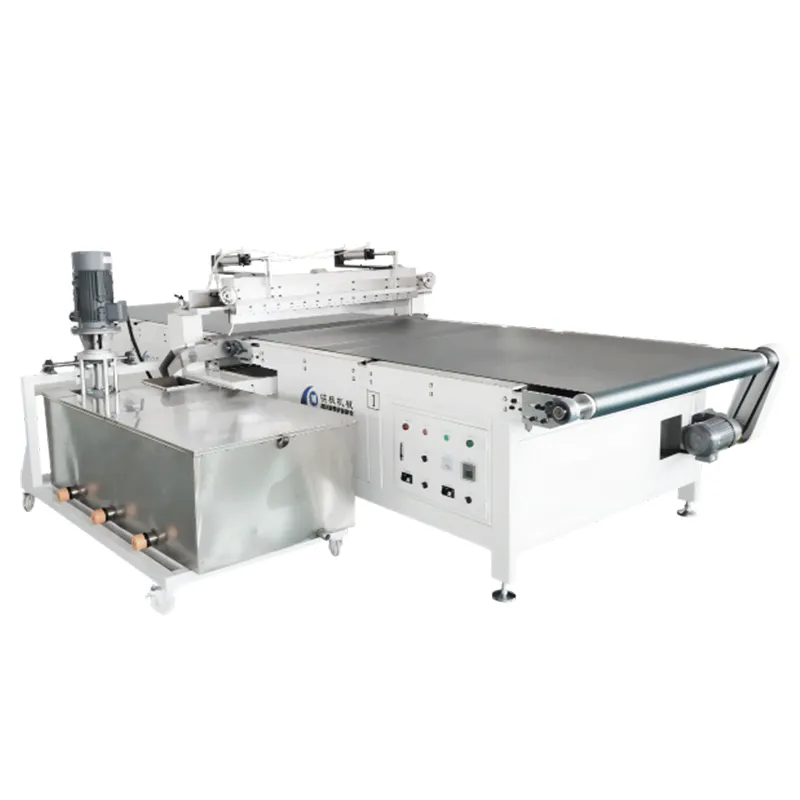
How do automatic curtain coating machines work?
An automatic curtain coating machine is an industrial machine that forms a paint curtain by the paint flow system and then coats workpiece surface fully automatically with the paint curtain. Its English name is Automatic Curtain Coating Machine. “Curtain Coating” means the coating method of painting a film in curtains (the film is continuously moving down), that is to say, first a paint curtain is formed so that the paint covers the surface of a workpiece uniformly when the workpiece is brought forward.
Pouring the sheet or workpiece into the coating area through a conveyor system, its surface goes through this paint curtain and gets uniformly covered with paint. The surplus paint is then recycled back into the tank through the recovery system, filtered and reused at the same time, thereby reducing loss of materials.
Essentially an entire automatic curtain coating machine involves several modules such as:
• automatic delivery conveyor;
• paint storage and circulation equipment;
• coating head unit;
• volume adjustment equipment;
• film thickness adjustment system;
• paint recovery and filtration unit;
• dry-off system or UV curing unit;
• intelligent control system.
The worker needs to adjust the conveyor speed, coating film speed and coating film thickness parameters only once, and the whole work from paint application to drying will be completed within one working shift with the machine.
The fundamental difference between an automatic curtain coating machine and a traditional spray gun is in the way paints are delivered. In order to reach from the nozzles to the workpiece surface a spray gun has to disperse a considerable amount of paint, while on the other side curtain coating machine is not producing such a huge amount of airborne paint particles, which is good for the environment, but at the same time it is better in terms of paint economy.
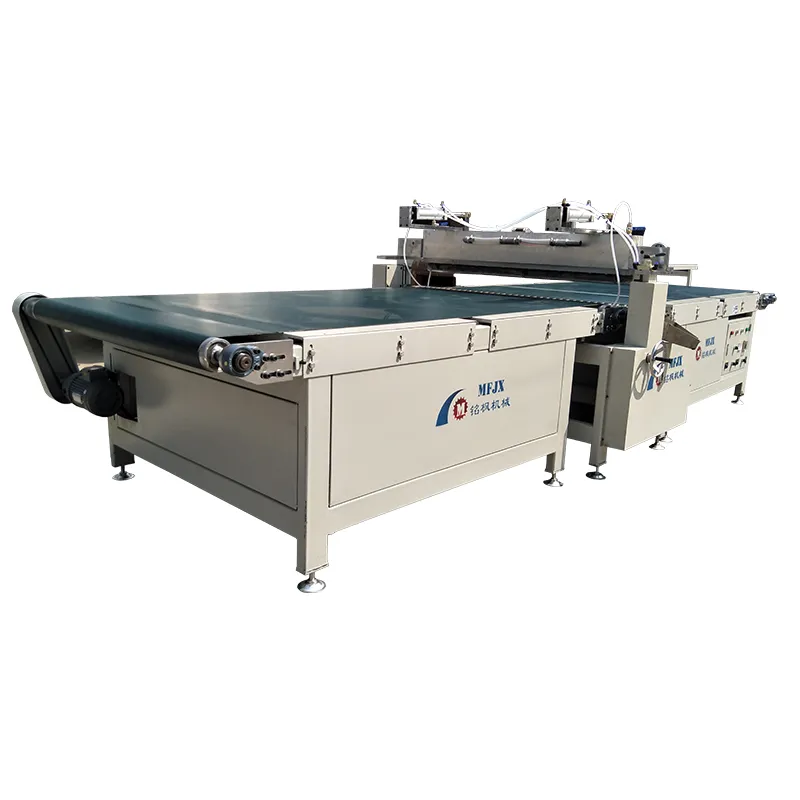
Why is it that most coating processes nowadays are done with auto curtain coating machines?
1. Uniform coating with less variation, resulting in stable product quality
The thickness of the coating is actually quite important to the overall product quality. It is one of the major aspects of product quality. Take furniture panels, for example. The smoother and flatter the paint film the better for the furniture. Similarly for metal sheets, corrosion resistance relies heavily on a complete coating which is what they look for. Electronic product cases, on the other hand, seek for consistent color and appearance.
In contrast, manual coating methods were prone to inconsistencies as hand pressure, speed and differences in workers experience etc. will result in some places being overcoated and others being thinly coated. Automatic curtain coating machines, with the aid of the machinery, can continuously monitor the flow rate of paint and controlling the speed of workpiece movement as well thus ensuring the same coating effect on every product from different batches.
With the automation in coating, the thickness of the coating layer is kept reasonably stable. As a result, these machines are very suitable for production that demands a highly smooth surface like high-gloss furniture panels and decorated door panels, and building decorative materials among others.
Constant quality of output means less defect occurrence and waste. Some factories report up to forty percent savings on the number of retaken products after they replaced the manual coating with fully automated devices where human error is almost eliminated. Still, actual numbers depend on the production technique of the company.
II. Large productivity, perfect for volume continuous production
Manufacturers are getting to appreciate the advantage of a small time taken of production which is very much a reason to consider automated spray coating methods.
Mechanization also makes the furniture panels’ processing extremely simple; starting from delivering the panel, through paint application, to the curing process, everything is done automatically and does not require human interference.
Air brush, on the other hand, cannot be operated without a human, unlike the fully automatic ones which can work independently and produce with incredible speed in a single line. To be precise, in one of the typical coat-applied fully automated lines at a speed of about half a kilometer per hour, just the speed of a conveyor belt.
Auto coating, in furniture, decorative board production, as well as metal tape (metal strip) production, all involve items of the same size produced in large quantities, automatic coating is definitely suitable.
III. Paint Saving Increase, Manufacturing Cost Reduced
A great shortcoming of spray techniques is that atomization causes a lot of paint to end up being dispersed in the air. Therefore, besides getting the loss in paint in form of mist, a separate step for exhaust purification has to be carried out.
Paint which is leftover from the painting operation in automatic machine painting is recirculated so the amount of waste is negligible.
A paint shop’s paint usage with an automation paint coating method has been proven higher compared to other conventional paint application methods. So even if a production plant is making slight savings every time from the use of the paint equipment, it will sum up and save the raw material expenses significantly if the plant is involved in a continuous or large production.
In the case where a manufacturer of furniture panels who regularly need to buy paint uses several or hundreds of tons at maximum annually for paint. If a production machine leads to a saving of 10% on the use of paint, it can result in about ten thousand yuan reduction in paint cost which is not a negligible number.
IV. Low human factor, more auto production
In general, nowadays labor cost and finding suitable skilled labor has become quite difficult for the production industry. Companies have been forced to develop the production to fully automatically operated machines so that they can have the production still on even when man power is down.
If you can hook up a fully automatic curtain coater machine to automatic feeding systems, UV cures, dry ovens, and a smart inspection system, it will make for a really completely automatic coating operation.
In the modern world’s manufacturing process, human labor has mostly only been reduced to operating the machines manually as well as the adjustment of the working parameters and performing regular checking on the equipment as against a manual continuous work on the materials that used to be done in coating work which was tiring and repetitive. In this way, physical effort is being relieved to a certain extent and the level of safety in the operation is increased.
What is the difference between automatic curtain coating machines and conventional spray coating methods?
Though the two types of technologies, automatic curtains and spray coating, both belong to the category of surface coating techniques, they are applied very differently in different settings.
Spray painting is the ideal technique for complicated shapes, curvilinear surfaces, and products requiring coverage at multiple angles. For example, it is more effective than other methods for painting automotive bodies and other complex mechanical components.
The main application of automatic curtain coating machines is coating flat materials and products produced in continuous runs, the machine types include for instance :
Wood Panels;
Mdf Panels;
Metal Sheets;
Glass;
Plastic Panels;
Decorative Products;
From a production efficiency aspect, automatic coating machines handle high-speed mass production much better. From a material utilization perspective, automatic machines are better because the use of coating material is reduced due to very little or no loss. In addition, from the point of view of the environment, automatic coating machines produce significantly less waste. Therefore, the pressure of pollution control is reduced.
Their selection of a production method should not be based on which is "high-tech," but on an appraisal of the product, the scale, and the quality desired by the company.
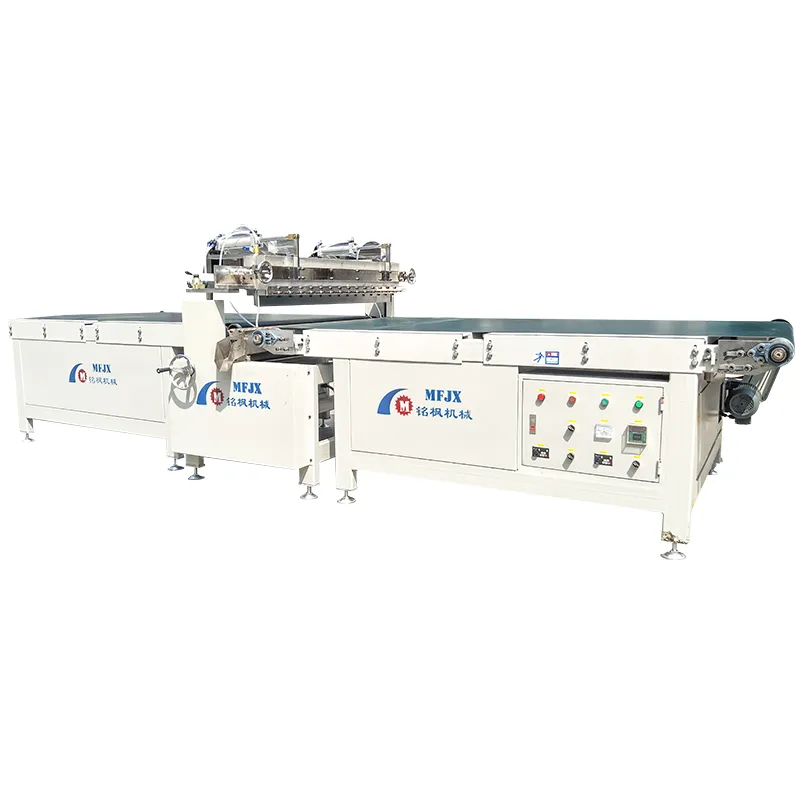
Which industries are extensively using automatic coating machines?
With the continuous development of the automatic coating technology, its industrial application has gone far beyond the traditional sectors like furniture manufacturing. Furniture manufacturing still remains the major area for adopting automatic coating machines because almost all the product lines from wooden doors to office furniture and other decorative panels involve one-layer after another coating operations. With the help of UV curing, automatic coating machines are able to carry out the whole paint job like primer, topcoat and finish layer to meet the production deadline.
In the construction decoration field, automatic curtain coating machines are also widely used for processing large-area sheets. Aluminum plates, aluminum composite panels or flame-retardant boards are first treated with coating materials to enhance water resistance, corrosion resistance and decoration effect. Automatic curtain coating machines can be continuously operated to produce large-sized panels which results in great improvement in the rate of production.
In addition, industries like the automotive interior components, consumer products housing as well as the glass and electronic industries are increasingly turning to Automatic Curtain Coating Machines as their solution for functional coating applications.
What materials can automatic curtain coating machines process?
One reason why automatic curtain coating machines have rapidly gained widespread acceptance in today’s coating industry is because of their strong flexibility in the kind of materials they can handle. Although curtain coating technology was primarily applied for wood and furniture panels at those early years, now automatic curtain coating machines can deal with various different kinds of flats materials such as wood, engineered wood, metals sheets, glass, plastics and composites after further improvements had been made to machine components, coating systems and automatically control technologies.
Yet, it is essential to keep in mind that not every type of material is a natural candidate for the curtain coating method. Automatic curtain coating machines work best with products that are relatively flat surfaces, continuous conveying, and needing large-area uniform coating.
In case of material selection, companies should do an overall analysis taking into consideration factors such as material properties, types of coat, size of a product, and final desired performance.
I. Wood and Engineered Wood Materials: The Most Mature Application Area for Automatic Coating Machines
Wood, wood-based composite products and furniture panels are the first and most advanced application of automatic coating machines today.
Manufacturing of furniture usually involves a number of coating operations. MDF boards, medium-densityfiberboard, plywood, particleboard, wooden panels for doors, cabinet door panels, and decorative panels require different coatings such as primer, color-correction paint, topcoat, and protective coat. Manual brush painting, besides being slow, is subject to skill levels of workers leading to color and surface finish differences between different batches of work.
Automatic coating machines, on the other hand, can get to do the perfect same result by very exact handling of paint quantity and speed of delivery. For example, in a UV painting line for furniture, automatic coating machines are often used along with UV drying machines. After the panel is coated the paint gets into the drying chamber, that hardens paint film instantly, yielding a bright glossy finish of high wear resistance.
Currently large furniture plants have automatic coating machines in production lines running continuously. An entire automatically operated furniture coatings production line is able to include processes like feeding, color application via paint mist, coating film smoothing out, exposure to curing light through UV lamp(s), and checking for conformity.
The results from real-life furniture industry use case show, the time for panel coating could have tripled as compared to the traditional hand-painting if companies go for automatic spray coating machines.
Another factor the rework level of a product is significantly less because of having a more stable coating. This reduction is the biggest reason to go with the automated spray coating machines.
II. Metal Sheets: Essential for Corrosion Resistance and Decorative Features
In addition to wood, metal materials are another significant application of automated paint spraying machines.
Types of metal processed are:
• Aluminum sheets
• Galvanized steel sheet
• Stainless steel sheet
• Color-coated steel sheet
• Aluminum-plastic composite sheet
The mechanical characteristics of steel are very good. However, if steel is exposed to weathering, chemical environments or moisture over a long time, the material will easily be oxidized and corroded. So a lot of metal items need to have protective coatings, in order for them to look nice and also get the benefits of protection from the elements.
An automatic paint spraying machine is able to apply a uniform layer of coating on the surface of the metal sheet, and will maintain a consistent thickness of the coating throughout. For example, metal panels used in building curtain walls, and decorative metal panels as well as industrial machines’ casings can all be surface treated by curtain painting.
Compared to conventional spraying, automatic curtain coating machines offer several major benefits when they are used to process metal sheets:
First of all, the coverage is more even. The metal boards are large and if the spraying settings are not perfectly set, there is going to be coating differences in some spots. It works to evenly cover the whole surface.
Secondly, there are higher material savings. The coating which is left over gets put back into the recycling system so that there is hardly any waste material.
Thirdly, the use of an automatic curtain coating machine suits continuous production very well. In other words, if a metal sheet plant requires the processing of thousands of square meters of materials daily, the continuous operation of curtain coating machines could easily cover such a big demand.
III. Glass Panels: Satisfying the Need for Functional Coatings
In fact the glass industry is also among the fastest growing segments for the use of automatic curtain coating machines in recent times.
Due to their extremely smooth surface, glass panels are very suitable for the execution of curtain painting operations. Automatic curtain painting machines will allow for the preparation of the desired level of coating and evenness of the finished paint film.
It is possible to achieve such characteristics as:
• Anti-fingerprint coating;
• Anti-condensation/fog coating;
• Anti-glare coating;
• Decoration;
• Protective layer.
E.g., during mass production of glass for kitchen appliances, decorative glass used in buildings, and glass for new energy vehicles, there may be a need for special treatments like surface protective layers or other coatings.
Since it is very important for glass to look well, in cases where any defect in the coating process is detected it might have a negative impact on the quality. Because of this very reason, automatic coating machines’ reliability and capacity for precise control are two key advantages they possess.
With varying of coating speed, paint viscosity and the way curing is done, glass films that vary in thickness and require different properties can be made.
IV. Plastics and Composite Materials: Meeting the Requirements of Functional Surface Treatments
A great variety of plastic products have led to increased usage of surface coating in the form of decoration or improvement of the properties.
Automatic painting machines can apply coatings onto :
• ABS sheet;
• PVC sheet;
• Pet sheet;
• Acrylic sheet;
• Plastic decorative parts;
• Composite material sheet.
Plastic materials usually have lower surface energy which makes the ordinary coatings sticking poorly. So, depending on the type of product the manufacturer may need to do pre-treatment like plasma treatment, corona treatment or primer treatment before automatic coating machine to strengthen the coating bonding.
In the manufacturing of consumer electronics and the new energy devices sector, plastic cases are treated for durability, resistance to scratches and UV resistance with an automatic coating system that produces a dependable protective layer.
With advances in smart home appliances, consumer electronics and new energy devices, the demand for surface treatments and functional films on plastic-composite materials will continue to grow. As a result, automatic coating machines will find new potential applications.
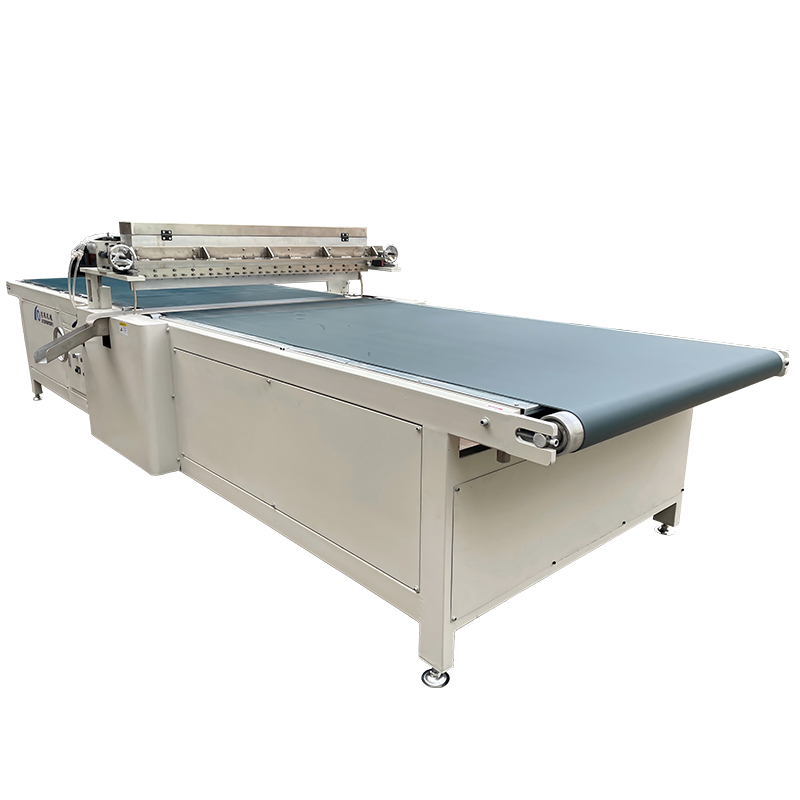
Are Automatic Curtain Coating Machine and Automatic Roller Coating Machine Different?
If a company produces coatings in the industry sector, the focus will generally be on automated curtain and roller coating machines, since both machines are coating machines with automation.
Although production efficiency can be improved by both processes, they differ substantially in terms of the technology they employ.
With rollers, automatic coaters mainly apply a coating film in one stroke through direct contact of the coating roller with the workpiece’s surface. With an automatic machine using a curtain of paint, one gets a steady flow and the object to be coated moves through this curtain and is covered.
The following are areas where automatic roller coating machines are more effective:
• Products with thickness control requirements;
• Workpieces requiring single-sided coating;
• Hard and smooth materials.
The below are the cases where automatic curtain coating machines are preferable:
• Large continuous flat sheets;
• Products needing rapid coverage;
• Running multiple coating jobs in succession.
To give a real-life scenario, in the furniture business, a furniture maker might apply priming through the use of automated roller coating devices and the finishing coat through automatic curtain coating machine since it offers big area coating.
So, essentially, these types of machines do not replace each other, instead, in a production cycle, each plays to its strength.
FAQ
1. Which industries are suitable for automatic curtain coating machines?
Automatic curtain coating machines are mainly used in furniture manufacturing, building decoration, electronics, glass processing, automotive parts, plastic products, and composite material processing industries. As long as the product surface is relatively smooth and continuous, high-efficiency coating treatment is required, an automatic curtain coating machine can be considered.
2. What are the advantages of automatic curtain coating machines compared to spray coating equipment?
The biggest advantages of automatic curtain coating machines are high paint utilization, more uniform coating, faster production speed, and less paint mist. For large-area flat products, automatic curtain coating machines generally offer better economic benefits.
3. What materials can automatic curtain coating machines process?
Automatic curtain coating machines can process wood, engineered wood, metal sheets, glass, plastic sheets, and various composite materials. Specific applications require adjustments based on material surface properties and paint type.
4. What equipment is needed to support an automatic curtain coating machine?
Typically, a feeding system, leveling equipment, UV curing machine, hot air drying equipment, and testing equipment are needed, depending on the process configuration, to form a complete automated coating production line.
5. Is the maintenance of an automatic coating machine complex?
Modern automatic coating machines employ a modular design. Routine maintenance mainly includes cleaning the coating head, inspecting the paint circulation system, replacing filter components, and maintaining the conveying system. Proper maintenance can effectively extend the equipment's lifespan and ensure long-term stable operation.